The Financial Literacy Crisis No One Is Talking About
Here’s a statistic that should concern every American.
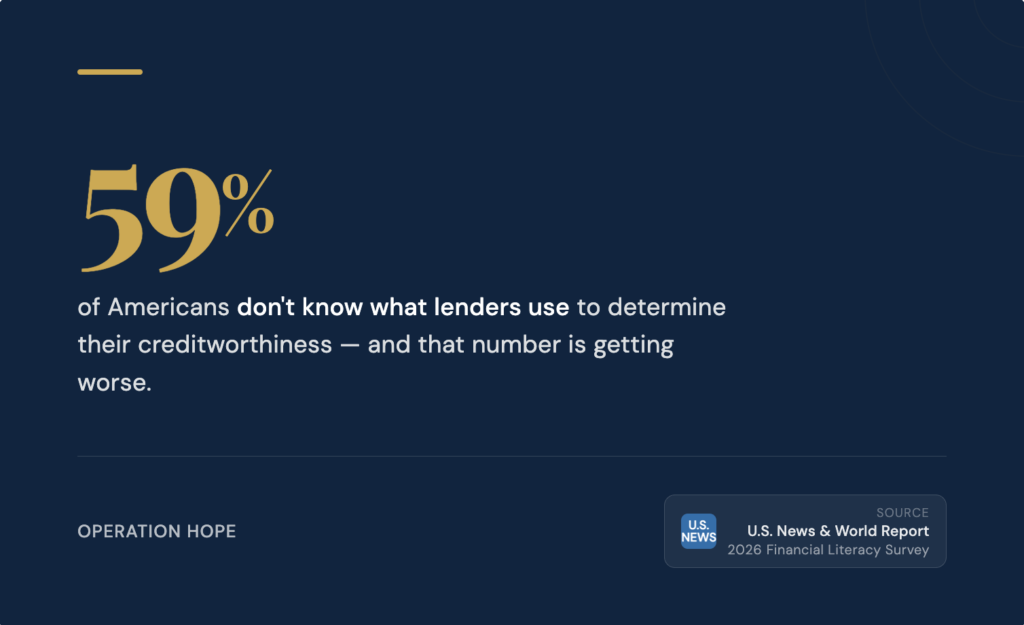
According to a new survey from U.S. News & World Report, 59% of consumers don’t know that lenders use FICO scores to determine creditworthiness.
Let that sink in.
Credit scores are one of the most powerful forces shaping a person’s financial future. They determine whether you can buy a home, finance a car, start a business, or even qualify for an apartment. And yet the majority of Americans don’t understand how the system works.
What makes this worse? Most people think they do.
More than half of survey respondents described themselves as “very knowledgeable” about personal finance. But when asked basic questions, many revealed serious misconceptions:
- Nearly 60% believe carrying a credit card balance improves their score
- 44% can’t distinguish between a credit score and a credit report
- 43% think married couples automatically share one credit score
I have a name for this. I call it being confidently wrong — and it may be more dangerous than simply not knowing at all. Because when you don’t know what you don’t know, you don’t go looking for the answer.
Financial Illiteracy Has Real Consequences
When people enter adulthood without financial education, they learn through mistakes. Forty percent of survey respondents said they maxed out their first credit card. Many didn’t understand interest. Some didn’t even know they had a spending limit.
That is not a personal failure. That is a systemic one.
Bad credit doesn’t just affect your interest rate. It shapes the ceiling of what’s possible for you — where you can live, whether you can build a business, how much of your paycheck goes to fees and penalties instead of savings.
This is why I have spent decades saying the same thing: financial literacy is the civil rights issue of this generation.
The Advice Problem
The survey revealed that 44% of Americans get their financial advice from friends and family, and nearly one-third don’t seek advice at all.
That means millions of people are navigating one of the most complex financial systems in the world on instinct and inherited behavior — much of which, through no fault of their own, is simply wrong.
Meanwhile, AI is accelerating scams. Products are becoming more complex. The economy is demanding more financial sophistication than ever — and we are sending people in underprepared.
The Way Forward
Financial literacy should not be optional. It should not be the privilege of people whose parents happened to have a financial advisor or a 401(k) conversation at the dinner table.
It should be in schools. It should be in workplaces. It should be in every community in this country.
At Operation HOPE, that’s exactly what we’re building — financial coaching, credit education, and entrepreneurship programs accessible to people who have historically been shut out of the financial mainstream.
Because here is what I know to be true after a lifetime in this work:
When you teach someone how money works, you don’t just change their bank account. You change how they see themselves. You shift them from someone the economy happens to — to someone who can make the economy work for them.
That is the power of financial literacy.
And it’s why we must make it accessible to everyone — not just the financially privileged.