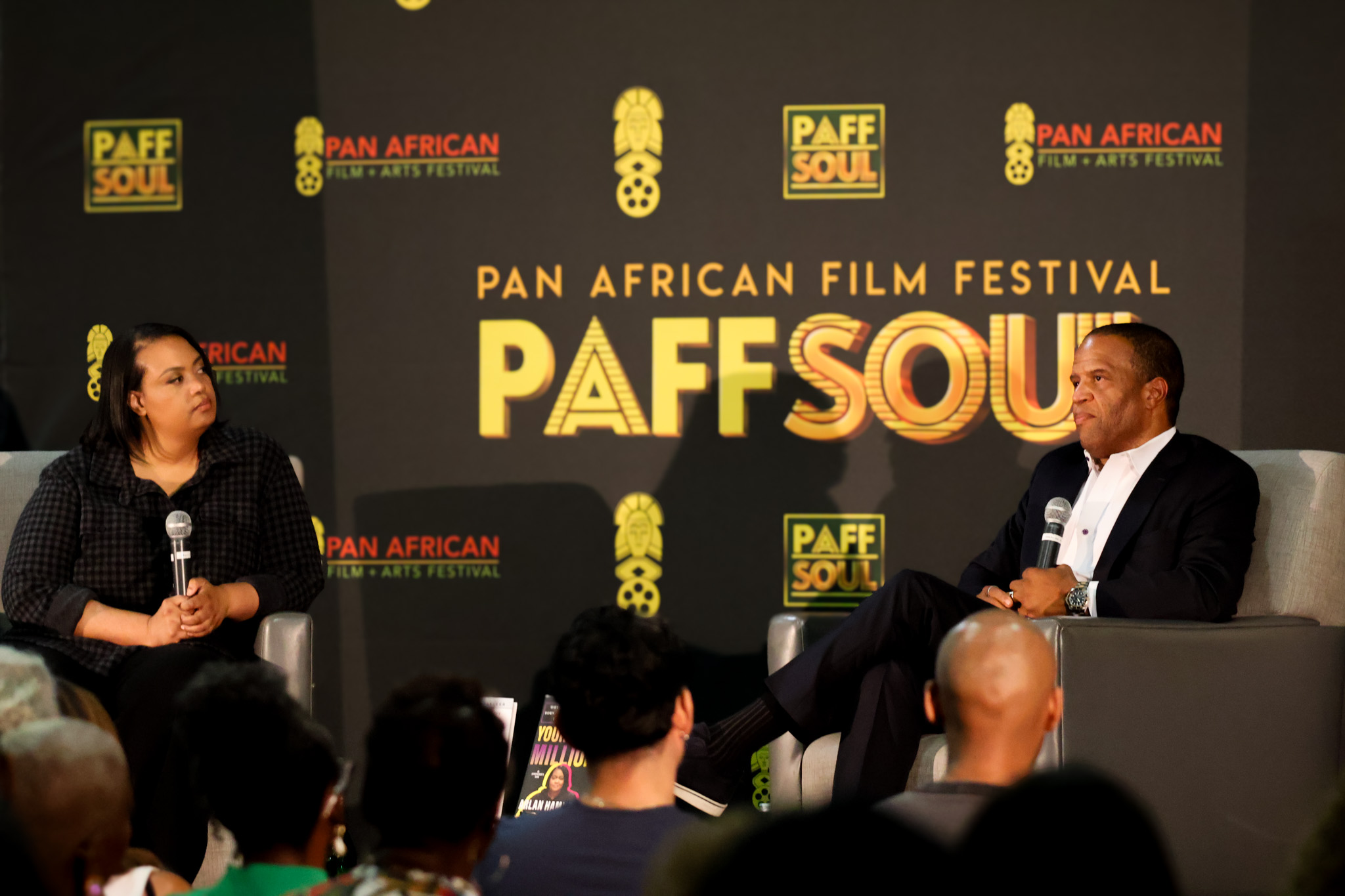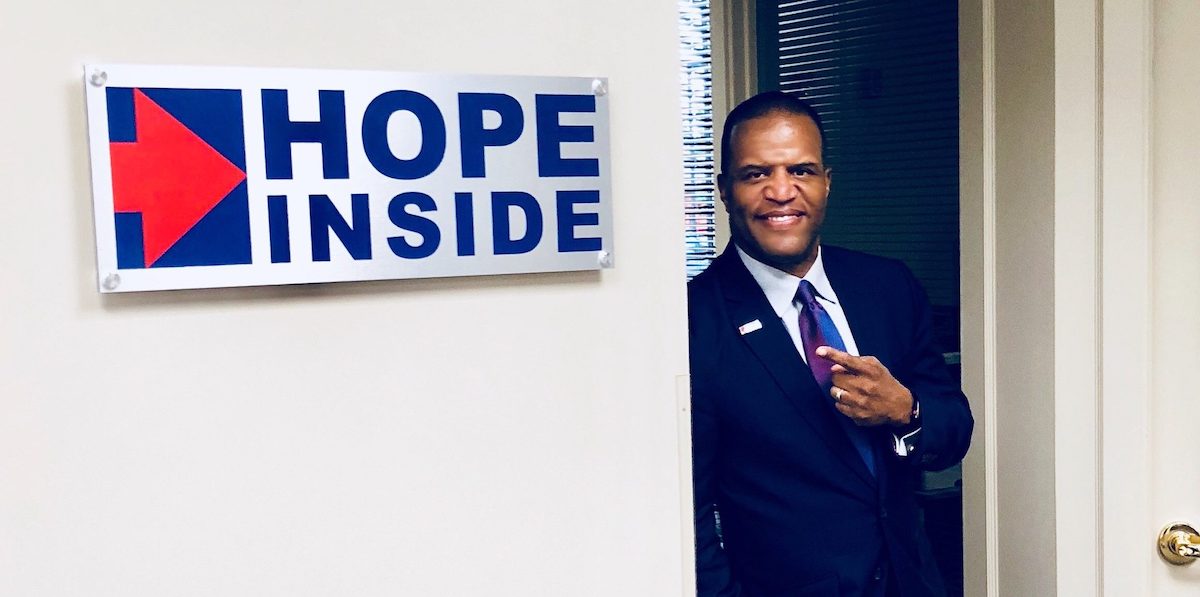
“If You Don’t Quit, You Can’t Fail.” What My Friend, Partner and Business Mentor Taught Me About Capital, Patience and Opportunity That Lasts.
Most weeks on Money & Wealth, it is just me and you. Me riffing, me teaching, me pouring out what I have learned the hard way. When I bring a guest on, you know they have earned the seat. I have had Michael Milken. I have had Van Jones. I have had heroes and sheroes I respect and admire.
But this one is personal.
If you took a survey of my podcast over three seasons, you would find one name more than almost any other: Ambassador Andrew Young. He is my mentor for moral authority, civil rights and dignity. And when it comes to understanding how capitalism and free enterprise actually work — how business works, how fairness works in business — there is another name I keep coming back to.
Tony Ressler.
Tony is my friend. He is my business partner. He is my business mentor. He is, as I like to say, my brother from another mother. Just before we recorded, we went from talking about the state of the world on his patio to running waves together in the ocean like we were both twenty years old. That is how comfortable I am with this man.
I trust him. I believe in him. And I want you to listen to him.
I have come to think of Tony as something more than a great investor. I think of him as America’s Chief Opportunity Officer. I told him that to his face. Now I am telling the world.
Who Tony Ressler Is
Let me get the formalities out of the way, because the résumé matters.
Tony Ressler is co-founder and Executive Chairman of Ares Management, one of the world’s leading alternative investment firms, with more than $600 billion in assets under management across credit, private equity, real estate and infrastructure. He began his career on Wall Street at Drexel Burnham Lambert. When Drexel collapsed in 1990, his career did not collapse with it. He helped co-found Apollo that same year, which became one of the most important alternative investment firms in the world. Then in 1997 he co-founded Ares and built it from an entrepreneurial shop into a global institution.
You may know him best as the principal owner and governor of the Atlanta Hawks, leading the group that acquired the franchise in 2015. But his commitment to Atlanta goes well beyond basketball.
Tony grew up in Washington, D.C. and Long Island. His father was an attorney and a World War II veteran. He studied at Georgetown’s School of Foreign Service and thought he might go into government. A State Department internship taught him that working for government was not his calling, so he chose the private sector and earned his MBA at Columbia.
With his wife, the actress Jami Gertz, Tony has become a serious philanthropist — supporting education, underserved communities, entrepreneurship and pathways to economic mobility. He has been a supporter of Operation HOPE and our Financial Literacy for All work. And he was one of the people who kicked my rear end and told me: John, focus on financial literacy. Don’t get distracted.
Tony has spent his career recognizing value before everybody else did. In companies. In communities. In cities. And in people.
“If You Don’t Quit, You Can’t Fail”
When people see a name like Tony Ressler on every list of the most successful people in America, they assume it was always easy. It was not. One of the great success stories of modern finance came out of one of the most spectacular collapses in Wall Street history. Rainbows after storms.
So I asked Tony: what did failure teach you that success never could?
His answer surprised even me. He said he never looked at it as failure. You fall down, you keep moving. You try to raise capital for a business and it does not come together? That does not mean you failed. It means it is going to take longer.
“If you don’t quit, you can’t fail.” — Tony Ressler
Then he said something I want every young person to hear. Stop chasing only your passion. Pursue what you are good at, and you will build a passion for what you are good at. And understand this: not everyone is built to be an entrepreneur, and it is a mistake to push people into that role when they don’t belong there. The ones who are know it is a 24/7 job.
As I always say, the only place success comes before work is in the dictionary.
Tony also broke down something most people never get taught: where money actually comes from. Today you don’t only go to banks. There are alternative asset managers, private investment firms, insurance companies, family offices and wealth channels. Knowing what each is looking for — and knowing when to borrow and when to raise equity, even though equity may cost you more — can determine whether a business grows or stalls. Education plus access to capital. As Tony put it, that is a powerful combination.
“What You Got in the Other Pocket?”
On this episode I told a story I had never told publicly. It is the real story of how my biggest business exit to date came to be.
I met Michael Arougheti, now CEO of Ares, at a financial services roundtable in Washington. We became good, good friends, and he invited me onto the board of a startup public company at Ares. I will always be thankful for that. It was the start of everything. No Michael Arougheti, and everything that then comes next — never happens. Thanks Mike. And that is when Tony Ressler came strolling down the hallway. Our first real conversation was short. Tony asked my advice on something, I gave him an answer he did not like, and he wanted me to skip to the end. Later he came back and told me I had been right. I would rather you respect me and learn to like me than like me and never respect me.
Years later, I was pursuing Tony as a donor for Operation HOPE. I flew across the country to his Los Angeles office, spending about $4,000 on travel to ask for $25,000. I gave him my best pitch. He said yes before I finished.
Then he looked at me and asked: “What you got in the other pocket?”
He meant: you just took money out of my left pocket for charity. Fine. You’re a smart guy. How are you making money? I told him about an idea for a single-family rental business that could bring affordable housing to our communities. I needed about $3 million. He said, “I’m in.” For half.
Two weeks later on a conference call, Tony said something I will never forget. Why do $3 million when you can do $30 million? Why do $30 million when you can do $130 million. We are in for $130 million. If I had been the one driving that car, I would have driven off the road.
Here is the lesson, and Tony explained it in the episode. A portfolio of leased affordable single-family homes is a high-quality asset you can borrow against. Raise X in equity and you can raise Y in debt. A bigger asset holds more value than a small one. That is what it means to understand leverage. That became the Promise Homes Company.
The Patience Lesson
I promised my investors I would get them in and out in five years. We grew from zero to roughly $150 million in assets. But the business was not ripe for the best sale yet. I was ready to sell early just to keep my word.
Tony said no. Actually, he used a stronger word than no. He told me I did not work that hard just to make rich guys richer. Take your time.
So I went back to work. I restructured the plan, brought in institutional capital from a major bank — proof that the market believed in what we were building — and that raised the value ceiling. We drew competitive bids, including one from KKR, and I sold the company on Christmas Eve 2021. Tony and Michael got their money back with a good return. My family got a life-changing one.
Tony was modest about it on the show. He called it simply what good business partners do: live up to your end of the bargain, and give honest advice about timing, price and buyer. And he reminded our audience that this does not mean everyone should go buy houses. We bought well, managed well, sold at the right time — and we gave renters financial coaching and a path from renting to owning.
You want to know what somebody believes in? Look at their checkbook. Tony has put real capital behind me and, without naming names, a dozen other entrepreneurs of color and women. He is not an ATM, so don’t go running to track him down. But he walks his talk.
Centennial Yards: Building a Downtown Atlanta Deserves
Atlanta is one of the top ten metro regions in America, with more than six million people, the busiest airport in the world and some of our nation’s greatest colleges and universities. For fifty years, it did not have the downtown to match. No large developer and no large pool of capital would take it on.
Centennial Yards is changing that. Tony and his brother Richard Ressler’s CIM Group are putting roughly $5 billion into the ground, building millions of square feet of experiential retail, residential and more. The plan Tony described includes a new Live Nation theater, a Cosm, about a thousand new hotel rooms, twenty-plus restaurants, and thousands of apartments — including affordable housing and student housing. It is one of the largest investments downtown Atlanta has ever seen, and I am honored to be an investor-owner.
This is a true private-public partnership, led by the private sector. Government could not do it alone. Business could not do it alone. And Tony made a point of bringing local investors to the table — including Ambassador Andrew Young, Dr. Sanjay Gupta, Grant Hill, Shaquille O’Neal, Usher, Killer Mike, 2 Chainz, Quavo and me. And 30 percent of contracts are going to minority- and women-owned businesses. Streets to the suites.
Tony, characteristically, was careful: we are not there yet, and I am not declaring mission accomplished. But downtown Atlanta is changing as we speak.
Good Ideas Over Ideology
This is the part of the conversation where I wanted you to see Tony’s heart, not just his head.
A lot of wealthy people are nice people with a blind spot: the common touch. Tony keeps one foot in every world. When young people say capitalism isn’t working for them, Tony does not say, well, it worked for me. He says that is not an answer. Listen to the criticism.
He gave examples. He disagrees with Medicare for All, and he showed his math on the cost. But he said the bigger mistake is ignoring that 25 to 30 percent of Americans cannot get decent, affordable health care. On housing, he argued that freezing rents only stops builders from building. The way to bring housing costs down is to build more housing at every price point.
Housing, health care, education, energy, food. Bring good ideas to serious problems. As Tony said on the show, quoting me back to myself: that is not red or blue. It is green.
And for the record, here is where I stand. People say they hate capitalism. No — they hate bad capitalism. They hate a rigged system where no matter how hard you work, you cannot get ahead. So let’s unrig it. That is what compassionate capitalism means: widening the fairway of opportunity. It is the whole argument of my book Capitalism for All.
Tony is doing the work. Through AltFinance — the $90 million, ten-year initiative Ares launched with Apollo and Oaktree — he helped build pathways for HBCU students into the alternative investment industry. As Tony put it, more people of color in finance is good for business, and it is good for people of color.
The Jobs of the Future — and the New Civil Rights
I asked Tony how we make this system work for young people, especially young people of color, so they see it as a path and not a trap.
His answer: make opportunity and affordability the pillars of both government and the private sector. And fix how we educate. Universities should prepare students for the jobs of the future, not the jobs of the past. He pointed to his friend Michael Crow at Arizona State University, which accepts most of its applicants, costs a fraction of elite schools, and trains students for the economy that is coming. When government, business and universities work together, AI becomes your friend, not your threat.
But young people have to do their part too. Follow the breadcrumbs being laid for you. Educate yourself about what the jobs of the future really are. And get your news from more than TikTok and Instagram. Read the Wall Street Journal. Read the Financial Times. Read Black Enterprise.
About six years ago, over one of our breakfasts, Tony told me something before it was fashionable. He honored the civil rights movement. But he said the new civil rights were things like low interest rates and access to capital and opportunity at scale. I call it civil rights to silver rights. He was ahead of his time.
He also told me: you make money during the day; you build wealth in your sleep. That is the difference between working and investing — in companies, in homes, in assets that grow while you rest. And it is why Tony believes, as I do, that every eleventh grader in America should be studying financial literacy.
His final message was simple. More affordable education. More accessible capital. For every community. That is how people better themselves, and how communities lift themselves up.
Listen, Share, and Go Change Your Life
This conversation is about more than finance. It is about compassionate capitalism in action — widening access to capital, education, mentorship, ownership, affordable housing, health care and the jobs of the future. It is about a man who connects the streets and the suites, and who backs his words with his checkbook.
Thank you, Tony, for your friendship, your honesty and your belief in me. And thank you to Michael Arougheti, whose flowers are coming on a future episode.
Watch or listen to the full episode now:
- Watch on YouTube: https://youtu.be/Izd1na9xFCI
- Listen on iHeartRadio: Tony Ressler on Creating Opportunity, Finding Resilience, and Rebuilding Atlanta
- Listen on Apple Podcasts: Money and Wealth with John Hope Bryant
- Listen on Spotify: Money and Wealth with John Hope Bryant
Want to take the next step? Get free financial coaching through Operation HOPE. Pick up my bestselling book Financial Literacy for All, and my new book Capitalism for All, where I lay out a blueprint for expanding opportunity and wealth for everyone.
The new color is not black or white, red or blue. It’s green. I want you to have some.
Let’s go.
— John Hope Bryant
#MoneyAndWealth #TonyRessler #CompassionateCapitalism #CapitalismForAll #FinancialLiteracyForAll #OperationHOPE #CentennialYards #Atlanta #Entrepreneurship #BlackEffect #iHeartPodcasts
John Hope Bryant — founder of Bryant Group Ventures, Operation HOPE, Inc, publisher of the Bryant Journal and author of his 7th book Capitalism for All: Inclusive Economics and the Future Proofing of America, now a bestseller. Bryant was recently recognized as a member of the Forbes 250 Greatest Living Self Made Americans, on the occasion of the 250th anniversary of America itself. Get the book →