From Customers to Capitalists: What ‘Capitalism for All’ Asks of Black America, and What It Offers the Nation
By John Hope Bryant, Founder, Chairman & CEO, Operation HOPE, Inc.
We were the capital before we were ever allowed to own capital.
By 1860, nearly 4 million enslaved Black people in this country were valued at roughly $3.5 billion. That made them the single largest financial asset in the American economy. They were worth more than all of America’s manufacturing and all of its railroads combined.
That same year, the lower Mississippi Valley had more millionaires than anywhere else in the nation. Every one of them was a slaveholder.
I start there not to relitigate history, but to settle an argument. Nobody can tell me Black people don’t know how to create wealth. We created more of it than anyone. We just weren’t allowed to keep it.
One hundred and sixty-six years later, the question in front of us is different. It is no longer whether we can generate wealth. It is whether we will own it. And that question has an answer. It is a business plan.
We Are the Market. We Are Not Yet the Owners.
Here is the good news, and it is very good news. Black buying power has grown 2.4 times since 2000, to about $2.1 trillion, according to the Selig Center at the University of Georgia. If Black America were a country, its spending power alone would place it among the 15 largest economies on earth.
We are 48 million people strong, and 52% of us are under 35. We don’t follow the culture. We set it, and America buys it.
This year, Black consumers will spend more than $370 billion on groceries, household goods, general merchandise and fast food. That is nearly 12% of all spending in those categories. One dollar in eight at America’s checkout counters is a Black dollar.
Now here is the hard news. Black Americans own just over 3% of this nation’s employer businesses.
Read those two numbers together. A $2.1 trillion market. About 3% of the businesses that employ people.
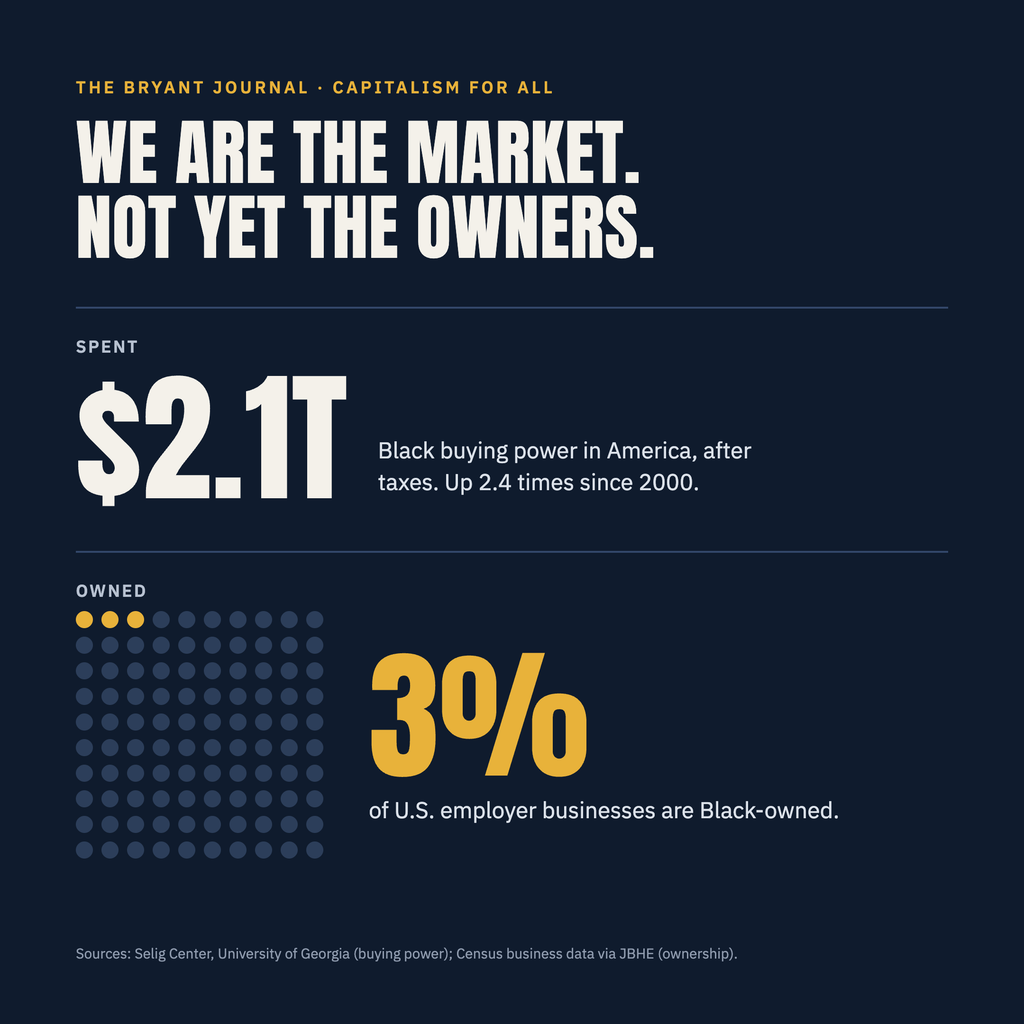
No industry tells the story more plainly than beauty. Black consumers account for 11.1% of all U.S. beauty spending. Black-founded and Black-owned brands earn just 2.5% of the industry’s revenue. In 2021, McKinsey put that at $6.6 billion of a $60 billion industry.
We buy one dollar in nine in America’s beauty industry. We own about one dollar in forty.
Nielsen found the same pattern across the aisles. Black consumers accounted for 85.7% of spending on ethnic hair and beauty aids, 22.4% of women’s fragrance and 20.1% of men’s toiletries. We were about 14% of the people and more than 20% of the customers.
“We are consumers in a capitalist economy, but too few of us are capitalists. That’s the work.”
And where we don’t own, we pay more. Black car buyers are twice as likely as white buyers to be charged a dealer markup. They are less likely to be approved for a loan than white borrowers with similar credit scores and incomes. Same car, same credit, higher price.
The Black homeownership rate was 44.2% at the end of 2025. The white rate was about 74%. Homeownership is how America builds wealth, and we are shut out of a third of it.
That is not a spending problem. It is an ownership problem. Ownership problems are solved with a plan.
A Black Business Plan for America
Capitalism for All starts from a simple belief. Capitalism is not the problem. Exclusion from capitalism is the problem. The answer is not to tear the system down. It is to let everybody in, and then teach everybody how to win.
So here is the plan. Five pillars, one goal: move Black America from customers to capitalists.
Pillar One: Own the Shelf
We already know which aisles we fill. Beauty, grooming, fragrance, personal care, the everyday essentials. Nielsen found Black consumers bought 18.9% of personal soap and bath products, 15% of bottled water and 17% of refrigerated drinks.
Every one of those categories is a business we could own. Retailers who count on our dollars should open their shelves, their supplier programs and their buyer meetings to Black-owned brands. And we should back our own. Our loyalty is earned, and it can be withdrawn. Sixty-seven percent of Black consumers say they will look for alternatives if a brand doesn’t stand with the causes they care about. We proved it in 2026, when Black dollars moved away from a major national retailer to smaller stores and online.
The lesson is not to punish. It is to build. Every dollar that walks out of one store should walk into a business we own.
Pillar Two: Fix the Credit Plumbing
A credit score is the real price tag in America. Ninety percent of Black car buyers name the best financing terms as a top-three reason to choose a dealership, compared with 78% of everyone else. For us, financing is the purchase.
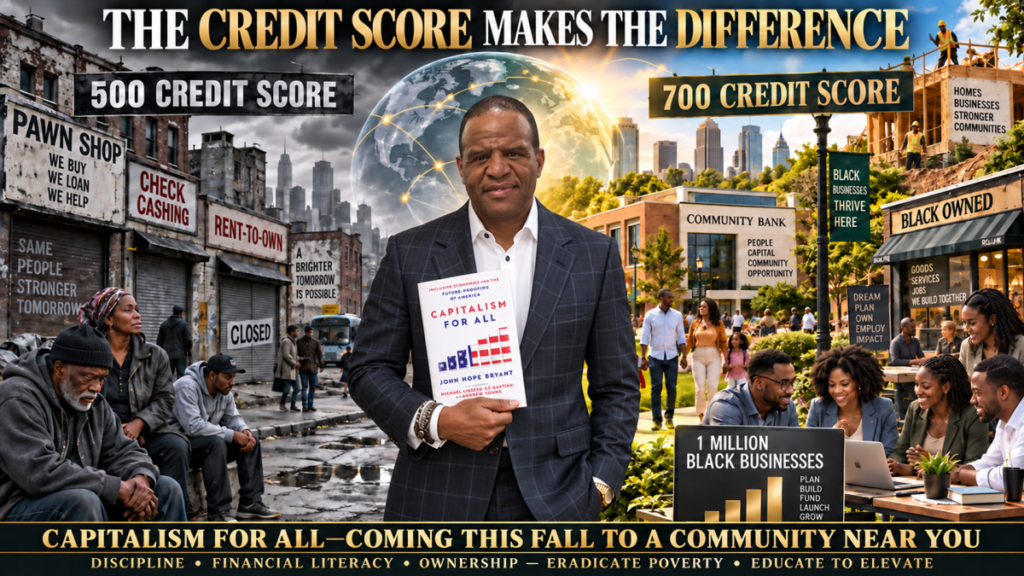
That is why I have said for years that financial literacy is the civil rights issue of this generation. A 700 credit score changes what a family pays for a car, a home and a business loan. It turns a renter into an owner, and an owner into an employer.
This is the work Operation HOPE, Inc. does every day, inside banks, schools and communities across the country. It is unglamorous plumbing. It is also the foundation everything else stands on.
Pillar Three: Grow Employers, Not Just Entrepreneurs
We are creating jobs, not just looking for them. The number of Black-owned employer businesses grew 62% from 2017 to 2023. In 2023, these more than 200,000 firms earned $249 billion, supported more than 1.8 million jobs and paid $69.8 billion in wages.
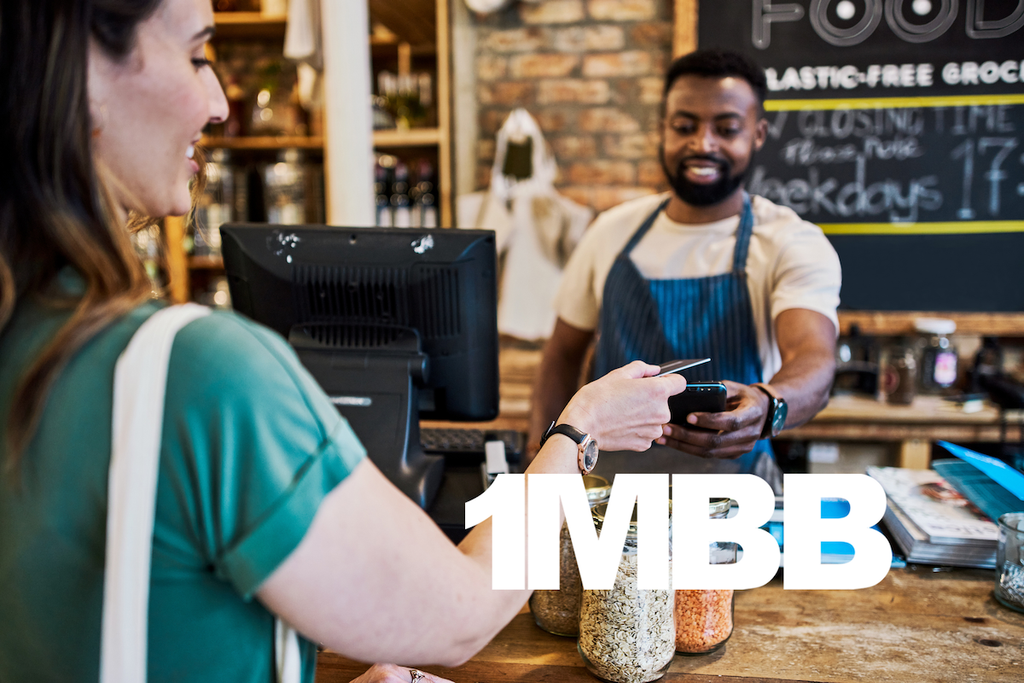
That is real progress. Now we have to scale it. The fastest path to Black wealth is not only more founders. It is more founders who hire their first, fifth and fiftieth employee. That takes capital, mentors and access to contracts. It is why we launched our 1 Million Black Businesses initiative at Operation HOPE.
We’re not waiting to be hired anymore. We’re hiring.
Pillar Four: Serve the Customers Everyone Else Ignored
McKinsey estimates Black consumers’ unmet needs in food, housing, health care, broadband and banking are worth $300 billion a year. It projects Black consumer spending will reach $1.7 trillion by 2030.
That is not a gap. It is a market. Grocery stores in food deserts. Clinics in places without doctors. Broadband in places the cable lines skipped. Banking for the unbanked. Artificial intelligence now puts world-class tools in the hands of a founder with a laptop. That lowers the cost of starting exactly these kinds of businesses.
The next great American fortunes will be built by serving the customers everyone else ignored. I want those builders to look like us.
Pillar Five: Protect the Workforce While We Build
No business plan works if families lose their footing on the way. More than 21 million Black Americans are in the labor force, about 13% of all U.S. workers. We drive the buses, staff the hospitals and keep the country safe.
Right now that workforce is flashing red. Black unemployment jumped from 6.0% in August to 7.0% in September 2026, the fastest one-month rise since the pandemic. The national rate’s increase, from 4.1% to 4.2%, came entirely from Black Americans losing work. Black women’s unemployment rose from 5.9% to 7.3% in a single month.
We have seen what happens next. In mid-2025, Black homeownership fell to 43.9%, the lowest since 2021. Redfin’s chief economist tied the drop to rising unemployment and federal layoffs. When jobs go, homes go.
So pillar five is a bridge. Retraining, emergency savings, credit protection and AI skills for workers in transition, so that a lost job doesn’t become a lost generation of wealth.
“When Black America catches a cold, the American economy is about to sneeze.”
This Is America’s Growth Plan
Let me be clear about who this plan is for. It is a Black business plan. It is also an American one.
Citigroup found that racial gaps in wages, housing, education and business investment cost the U.S. economy $16 trillion over 20 years. About $13 trillion of that was business revenue lost because Black entrepreneurs couldn’t get bank loans. Citi estimated that closing those gaps could add $5 trillion to GDP over just five years.
That is not charity. It is growth America is leaving on the table.
Every new Black-owned employer is a new taxpayer, a new customer for a bank, a new tenant for a landlord and a new paycheck in a neighborhood that needs one. When we grow, the country grows. That is what Capitalism for All means. Not a smaller pie divided differently. A bigger pie, with more people at the table who know how to bake.
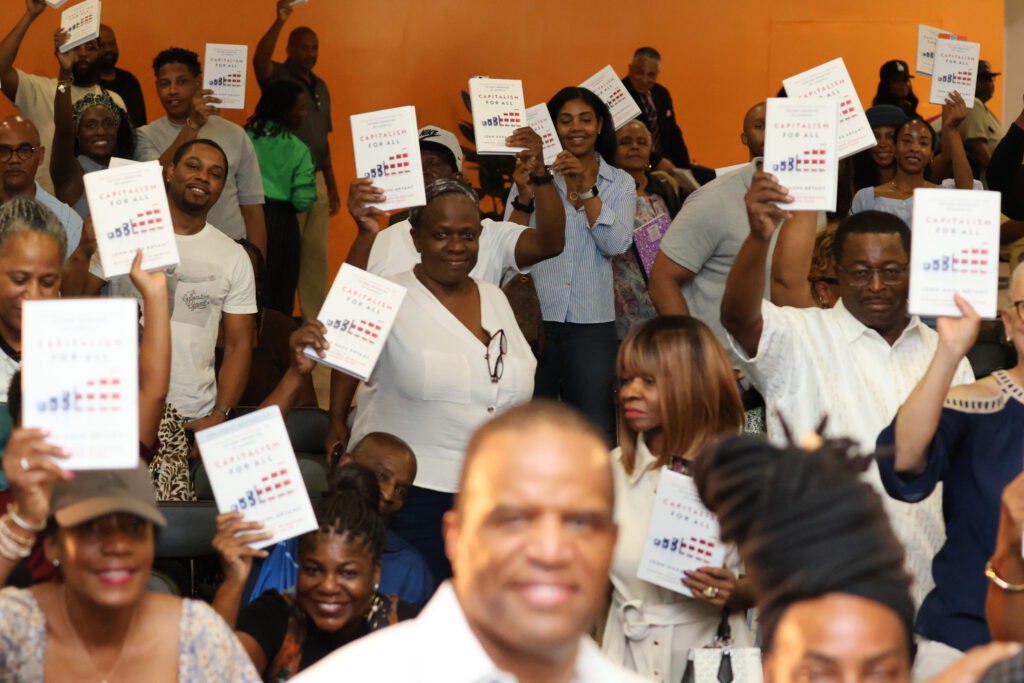
[PHOTO CALLOUT: Capitalism for All book cover, or JHB with business and civic leaders]
We were the capital. Today we are the market. Tomorrow, if we do this right, we will be the owners.
The plan is written. Now let’s go build it.
The work continues.
John Hope Bryant
John Hope Bryant — founder of Bryant Group Ventures, Operation HOPE, Inc, publisher of the Bryant Journal and author of his 7th book Capitalism for All: Inclusive Economics and the Future Proofing of America, now a bestseller. Bryant was recently recognized as a member of the Forbes 250 Greatest Living Self Made Americans, on the occasion of the 250th anniversary of America itself. Get the book →