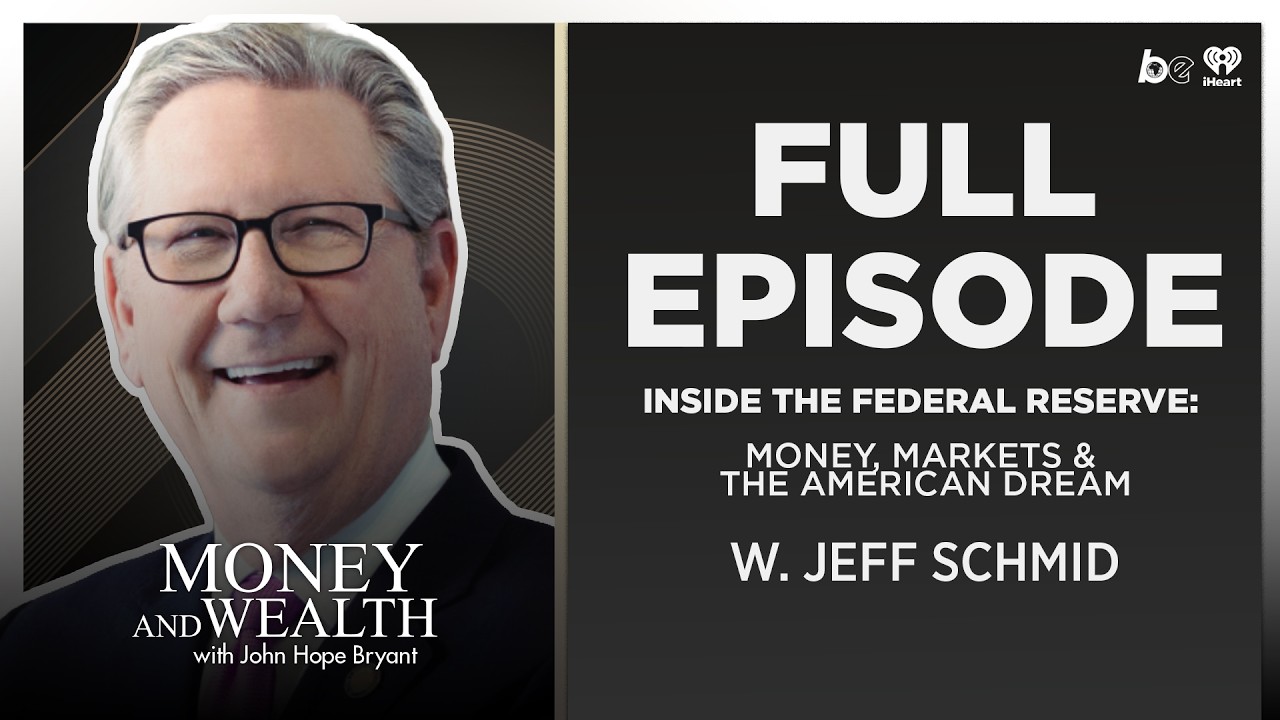
Most Americans live inside a financial system they do not understand, and fear grows where understanding is absent. That is why I invited Jeff Schmid, President and CEO of the Federal Reserve Bank of Kansas City and a member of the Federal Open Market Committee, onto Money & Wealth. He is also a longtime friend and a member of the Operation HOPE board of advisors, and he spoke here for himself and not in his official capacity.
It is easier for me to book a U.S. senator, a governor or a cabinet member than a sitting Federal Reserve official. People assume the Fed is secretive, that it belongs to Wall Street, that it does not care about them. I would call it discreet more than secretive. Jeff trusted us with an hour and eighteen minutes, and I mostly got out of his way.
Is the Fed government or private?
Jeff walked through the history. The first two Banks of the United States were chartered in Philadelphia and did not last. After the Civil War, banks printed their own money, and it looked a lot like today’s crypto debate, with everyone insisting their currency was legitimate. In 1913 Congress built the structure we have now: a Board of Governors in Washington plus twelve regional Reserve Banks, which he compared to a Senate and a House of Representatives. Kansas City is the Tenth District, the J on the dollar bill. Only Congress can change the system, and each Reserve Bank has a board of directors drawn from the private sector and the community.
The plumbing of money
The Fed does not print currency. The Treasury does that. The Fed distributes it, clears checks and electronic payments, and supervises the banks that move that money. Jeff described the Fed as the plumbing, and then gave a number that made me stop him: somewhere between five and ten trillion dollars moves through the system every day. He also explained FedNow, the instant payment platform that is ending the old float. I told him I miss floating checks in my twenties, and he told me about washed checks, which is how much of today’s payment fraud happens.
Fraud, AI and cybersecurity
This part of the conversation has changed what I am asking of our HOPE team. Jeff talked about the CrowdStrike outage, new software that can find holes in digital systems, and quantum computing that could crack encryption we once treated as impenetrable. I told the audience what I tell our coaches: the Federal Reserve will not text you, and before you send money to someone who sounds like a relative, ask for a code only the two of you would know. We spend a great deal of energy on AI and jobs. Fewer people are watching the back door.
Why the Fed moves interest rates
Jeff gave the clearest picture of the Fed’s job I have heard. Elected leaders drive the train, the American people ride in the cars, and the Fed is the rails. The two rails are stable prices, with inflation near two percent, and full employment. Keep them level and the train stays on track. Let inflation run to eight percent and a raise of three or four percent leaves you behind. The Fed sets short-term rates, and that is only the starting point for what you pay.
Why your rate is not the Fed’s rate
When the Fed rate is in the low single digits and your car note is eighteen percent or your credit card is twenty-six, the gap comes from your credit, your perceived risk and how much competition lenders face in your neighborhood. Higher costs push people toward riskier choices to outrun them. Jeff’s advice was practical. Use a credit card as a payment tool and not as a loan, and find a banker or a HOPE coach who can help you bring your cost of credit down to the single digits. If you only have time for one stretch of this episode, listen from about the fifty-ninth minute to the hour-three mark.
Know someone at the Fed
Jeff closed with three ideas he took from Capitalism for All: financial literacy, AI literacy and relationship capital. He wants people to know the Federal Reserve is approachable. Each Reserve Bank has education programs, tours and public resources, and if something looks like fraud you can call or walk into your local Reserve Bank and ask. We ended with the Freedman’s Bank, Frederick Douglass and Ambassador Andrew Young, and why he cares about the history of banking for formerly enslaved Americans. As we mark the 250th anniversary of this country, build more bridges and fewer toll bridges.
Listen and watch
This is one of the most important conversations I have had in three seasons of the show. Take notes, then share it with someone who has never understood how the money system works.
Watch the full conversation
Listen to the full episode of Money & Wealth with John Hope Bryant on iHeart, on the Black Effect Podcast Network.
— John Hope Bryant
John Hope Bryant — founder of Bryant Group Ventures, Operation HOPE, Inc, publisher of the Bryant Journal and author of his 7th book Capitalism for All: Inclusive Economics and the Future Proofing of America, now a bestseller. Bryant was recently recognized as a member of the Forbes 250 Greatest Living Self Made Americans, on the occasion of the 250th anniversary of America itself. Get the book →