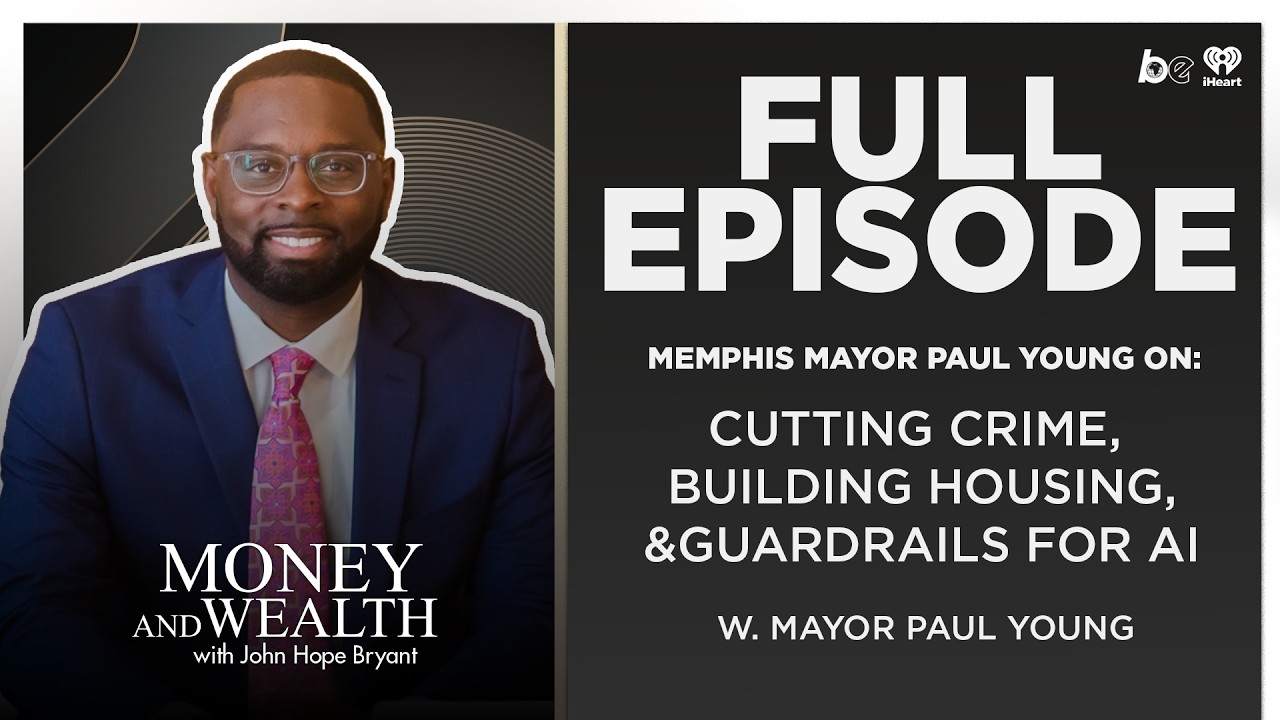
Most of my Money & Wealth episodes are solo, so when I bring on a guest, you should know I think they are best in class. This time I sat down in Memphis with a good friend, Mayor Paul Young, for a robust conversation about how a city really works, why he cannot just pop his fingers and get things done, and what is happening with AI and the data centers you have been hearing about.
Memphis roots, and a day I will not forget
We had just come from a book signing for Capitalism for All at a historic library across the street from what used to be the cotton trading hub on Union Avenue. I told Mayor Young something I had not shared yet. My second great-grandfather, George Young, was an officer in the Black troops who answered the call of the Emancipation Proclamation, escaped slavery and defended Memphis. I wondered whether he stood on the banks of that river with his musket. I also get emotional every time I come through the Memphis airport. I spoke here on the 50th anniversary of the sanitation workers’ strike, and I came on what I believe was Ambassador Andrew Young’s first trip back in decades after Dr. King was assassinated at the Lorraine Motel. Dr. King’s last book was Where Do We Go From Here, and it was about economics. That is the unfinished work.
Who Paul Young is
Mayor Young was born in Memphis. His father is a bishop and pastor, his mother a pastor, and his wife a doctor. At 12 he went to the inauguration of the first Black mayor of Memphis. He earned a master’s degree in planning and then an MBA, and instead of chasing money on Wall Street he went into public service, first as the city’s housing director and then as president of the Downtown Memphis Commission. I met him when he walked up to me in a public square and told me, when I am mayor, I am going to need your help. I respected that, and I sent him a contribution when he ran. In his first two years he has helped drive crime down about 40 percent. People complaining and criticizing is a cheap sport.
It is law enforcement and opportunity
The mayor said every room he entered when he took office, in South Memphis, North Memphis or East Memphis, wanted to know how to bring down crime. His approach is dual. Law enforcement is intentional about the 20 percent of individuals driving 80 percent of the crime, while nonprofits find people headed down the wrong path and change their direction. He called the debate over law enforcement versus opportunity an artificial one. It is both. And now that crime is moving in the right direction, nobody is doing victory laps, but the conversation can turn to income and wealth. If you really want to stop crime, give somebody an opportunity.
65 percent of the city, 9 percent of the ownership
Memphis is about 65 percent Black, but only about 9 percent of business ownership is Black, and the homeownership numbers are lower than they should be. That bothers the mayor, and he is not running from it. His goal is 10,000 new housing units by 2030, everything from single-family homes to multifamily. Memphis has lost about 35,000 people over the last 20-plus years, from roughly 650,000 to 615,000, mostly from the heart of the city. I call it reverse gentrification, a hollowing out. Mayor Young calls it economic flight. In the 50s and 60s it was white flight, and since the 80s it has been people of every color leaving for newer housing and a perception of safety. That is why lowering crime had to come first.
Training an army of developers
The city is training emerging developers, some who came from flipping houses or banking, and offering vacant tax parcels through requests for proposals. About 80 parcels went out, 18 different developers took part, and the mayor has attended groundbreakings for about seven of them. The housing does more than shelter families. It rebuilds the customer base for small business corridors that lost population, and it creates work for painters, plumbers, electricians and people cutting the grass. You cannot AI plumbing, by the way. I will add that the CEO of First Horizon Bank, when I asked him who I should meet in Memphis, said, meet Paul Young. A Black senior citizen from the neighborhood and a very conservative corporate executive can both tell you he is a good mayor. The mayor’s own line was that you have to be a great mayor who happens to be Black, not a Black mayor.
How big a city job is
Mayor Young runs about 6,000 full-time employees, about 2,000 part-time employees and a budget of about $905 million, close to a billion dollars. That covers trash, roads, police, fire, community centers, parks, libraries and the 311 line you call about a pothole. When Tennessee law changed and ended the city’s minority and women-owned business programs, he pivoted to a small business enterprise program that serves the same people within the law. Among the things he is proudest of is 901 Day, a celebration of the city each September 1 on Beale Street, a shift from a deficit mindset. The city also set goals of summer jobs for young people and getting 5,000 young people workforce-ready by 2030 in five fields: medical trades, construction trades, technology including AI, advanced manufacturing, hospitality and education. His advice for the frustration of the job is to keep talking, and keep doing.
AI and the data centers
Mayor Young separates two concerns that residents blend together: the data center as a building, with its power, air and water, and what AI means for jobs. The xAI project generated about $54 million in tax revenue in a single year across the city and county, equivalent to the taxes from about 12,400 homes valued at $300,000. Memphis is the first city I know of to pass a Community Benefit Ordinance, which sets aside 25 percent of those taxes to be spent within five miles of the facility. Residents chose through a survey, and their top request was home repairs. The company committed to a gray water facility that cleans wastewater to cool the computers and a nearby power plant, which has been delayed and resized, and the city sold the land with the right to take it back if promises are not kept. The mayor said the company has kept the promises it made so far, that he has questions about ethics and values, and that the city has capped water use at a million gallons a day while the aquifer has actually risen over the past decade. A 90-day executive order task force of experts and community members is now setting the guardrails.
My view on AI
Let me say what a mayor cannot. This is not a cassette tape or a DVD. Other than God, there has never been a more powerful source of intelligence than AI, and if we use it properly I believe it will help solve cancer. There are real risks too, and the people building it have said so. We had that with the nuclear bomb, and we also got nuclear energy and Chernobyl. We need government guardrails and studies on health and safe distances. But if we put our heads in the sand, China is not waiting. Your job will not be replaced by AI. It may be replaced by somebody who can use AI, and I want that to be you. Plumbers and electricians in data centers can make a couple hundred thousand dollars. I want mayors to cut the best deals and get a community compact around these centers, with investment back into the neighborhoods, not only property taxes. Do not become the chief criticism officer. Join the commission, volunteer, give suggestions.
Literacy, ownership and investing in Memphis
I believe financial literacy and AI literacy are the civil rights issues of this generation. I want to see child savings accounts for kindergartners in Memphis like we are doing in Atlanta, AI literacy taught up and down the school system, and small businesses growing around the tech companies. I am bringing our CIM BGV Impact Ventures affordable housing fund here, and I have committed to buy a couple of homes myself so I become a taxpayer. For anyone listening, the mayor said a three-bedroom, two-bath house runs about 220,000 dollars, roughly half the national average I quoted. Do not just write a check. Buy a home, start a business, invest in somebody starting one. This is compassionate capitalism, capitalism with a heart. Social Security, Medicare, Medicaid and public schools are already social programs, and even if you want to distribute money like a socialist, you first have to collect it like a capitalist. A shrinking city needs taxpayers.
Asked what he wants to be remembered for, Mayor Young said he wants people to remember this as the moment Memphis got it right, the moment Memphis changed forever. He would do all of it again the same way.
Watch the full conversation
Listen to the full episode of Money & Wealth with John Hope Bryant on iHeart, on the Black Effect Podcast Network.
— John Hope Bryant
John Hope Bryant — founder of Bryant Group Ventures, Operation HOPE, Inc, publisher of the Bryant Journal and author of his 7th book Capitalism for All: Inclusive Economics and the Future Proofing of America, now a bestseller. Bryant was recently recognized as a member of the Forbes 250 Greatest Living Self Made Americans, on the occasion of the 250th anniversary of America itself. Get the book →