Oct 19, 2026 · @John hope Bryant
Only 15% of the Americans we surveyed believe capitalism is working the way it is supposed to for hardworking people. And 87% of those same Americans are hopeful about their financial future. Both numbers are true at the same time. That gap between belief in the system and belief in yourself is the most important finding in our new HOPE Insider survey, and it is a message every leader in this country needs to hear.
They are not rejecting capitalism. They are asking to be included in it.
Every quarter, Operation HOPE, Inc. asks the people we serve how they are really doing. This quarter, more than 1,500 adults, small business owners and entrepreneurs answered. These are low- and moderate-income Americans. They are not pundits. They are living the economy every day, at the kitchen table.
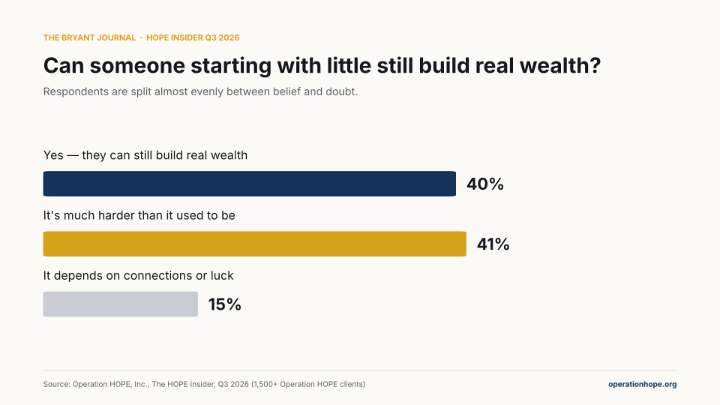
Only 15% told us capitalism is working as intended. About one in three said the system works, but mostly for people who already have money. Another one in three said it is broken and needs to be fixed.
Read that carefully. That is not a vote against free enterprise. It is a demand that free enterprise keep its promise. I have said for years that capitalism is the greatest wealth-building system the world has ever known, and that it is failing too many people only because too many people have never been invited in. Our clients are telling us the same thing in their own words.
Is the ladder still there?
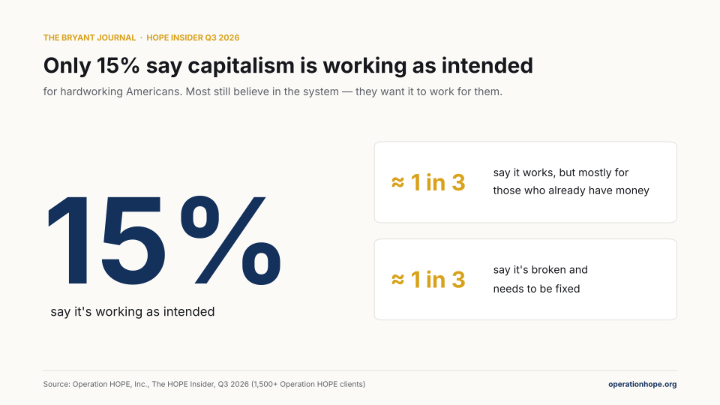
We asked a simple question: can someone starting with very little still build real wealth in America today? The answer came back almost perfectly split. 40% said yes. 41% said it is much harder than it used to be. Another 15% said it mostly comes down to connections or luck.
That 15% troubles me most. When people believe success is about who you know rather than what you know, they stop trying. Hopelessness becomes a policy of its own. The cure is not a speech. The cure is access: to financial literacy, to credit, to a banking relationship, to a mentor who shows you the rungs on the ladder are real.
A quarter of real progress
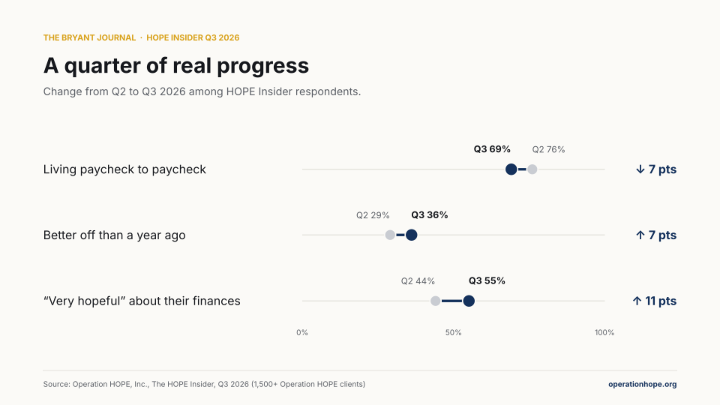
Here is the good news, and it is real. The share of respondents living paycheck to paycheck fell to 69%, down from 76% just one quarter ago. The share who say they are better off than a year ago rose to 36%, up from 29%.
Seven points in three months is not a rounding error. That is families who found a little room to breathe.
But I will not dress this up. Half of respondents told us their personal debt went up over the past three months. Progress and pressure are arriving at the same time. That is exactly when financial education matters most, because it is the difference between a raise that builds a cushion and a raise that disappears into the next bill.
Buy Now, Pay Later: still common, used more carefully
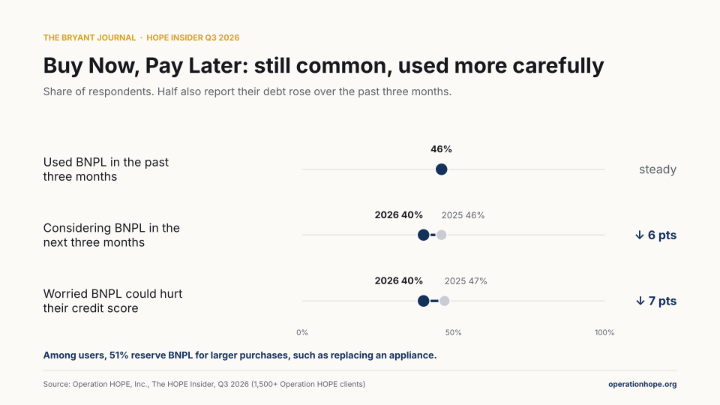
Nearly half of respondents, 46%, used a Buy Now, Pay Later service like Affirm, Afterpay or Klarna in the past three months. That is about the same as a year ago. What has changed is how people are thinking about it.
The share considering BNPL in the next three months dropped to 40%, from 46% a year ago. Among users, 51% said they save it for larger purchases, like replacing a broken appliance. Concern about the impact on credit scores eased to 40%, from 47%.
That tells me people are using these tools more deliberately. It also tells me we have more teaching to do. Credit is a tool, not a lifeline. Used wisely, it builds a credit score. Used out of desperation, it builds a trap.
The dream of a home is bending, not breaking
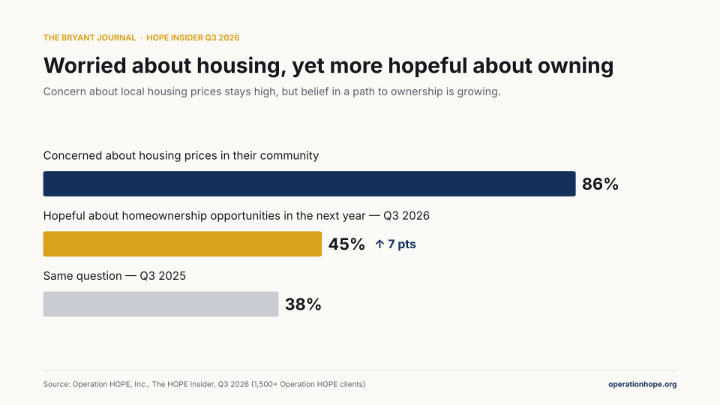
Housing remains the heaviest weight on the American family. 86% of respondents are concerned about housing prices in their communities, a level that has held steady for a year.
And yet 45% are hopeful that the housing market will open new doors to homeownership over the next 12 months. A year ago, that number was 38%. People are watching prices, studying their credit and getting ready. Homeownership is still the cornerstone of family wealth in America, and our job is to make sure that when the door opens, they are prepared to walk through it.
Hope just hit a record high
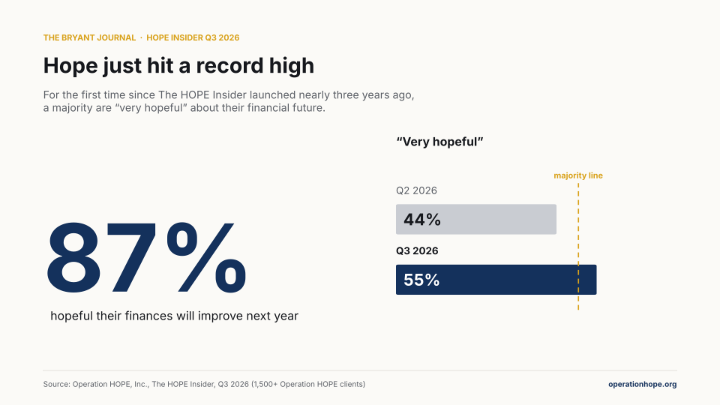
This is the number I want every policymaker, banker and CEO to sit with. 87% of respondents are hopeful their financial wellbeing will improve over the next year. 55% describe themselves as very hopeful, up from 44% just one quarter ago.
Since we launched The HOPE Insider nearly three years ago, a majority has never before expressed that level of optimism about their financial future. Not once. Until now.
Think about who these respondents are. Many are living paycheck to paycheck. Many are carrying more debt than they were three months ago. And they are still hopeful. That is not naivety. That is the American spirit. Hope is not a strategy, but it is the fuel every strategy runs on. When people have hope, they invest in themselves. They save. They start the business. They buy the home.
What happens when people get the tools
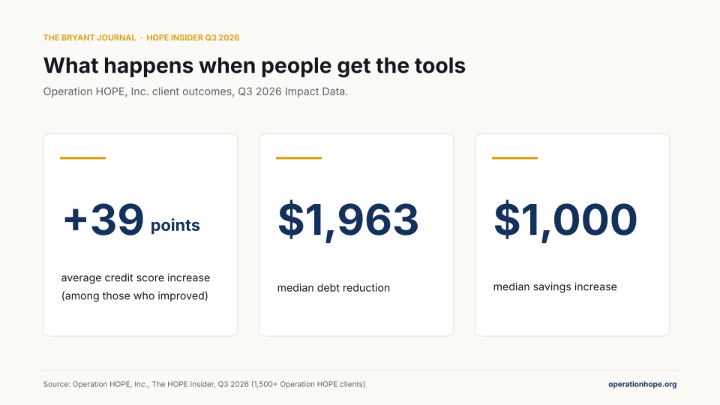
Hope matters. Tools matter more. Our Q3 2026 Impact Data shows what happens when hope meets financial education and coaching.
Among clients whose credit improved, scores rose an average of 39 points. The median client reduced debt by $1,963. The median client increased savings by $1,000.
A thousand dollars may not sound like much in a boardroom. At the kitchen table, it is the difference between a flat tire being an inconvenience and a flat tire costing you your job. This is what silver rights look like in practice: not charity, but capability.
Closing the hope gap
So here is what the data is really telling us. Americans have not given up on capitalism. They have not given up on themselves. What they are waiting for is proof that the system has not given up on them.
That proof will not come from slogans. It will come from leaders in business, banking and government choosing to build the on-ramps: financial literacy in every school, a banking relationship for every family, credit that builds people up instead of locking them out, and a fair shot at owning a home and a business.
This is the heart of Capitalism for All. Not less capitalism. More capitalism, for more people. The hope is already there. 87% of the people we serve just told us so. Our job is to make sure that hope has somewhere to go.
The work continues.
John Hope Bryant
About the survey: The HOPE Insider is a quarterly survey conducted by Operation HOPE, Inc.’s research team since November 2023. The third quarter 2026 survey gathered responses from more than 1,500 adults, small business owners and entrepreneurs who have used Operation HOPE’s financial wellness services. Full findings: operationhope.org/data-impact/the-hope-insider.
John Hope Bryant — founder of Bryant Group Ventures, Operation HOPE, Inc, publisher of the Bryant Journal and author of his 7th book Capitalism for All: Inclusive Economics and the Future Proofing of America, now a bestseller. Bryant was recently recognized as a member of the Forbes 250 Greatest Living Self Made Americans, on the occasion of the 250th anniversary of America itself. Get the book →