
She was born from the fight to end slavery. The chains are still there — if you know where to look.
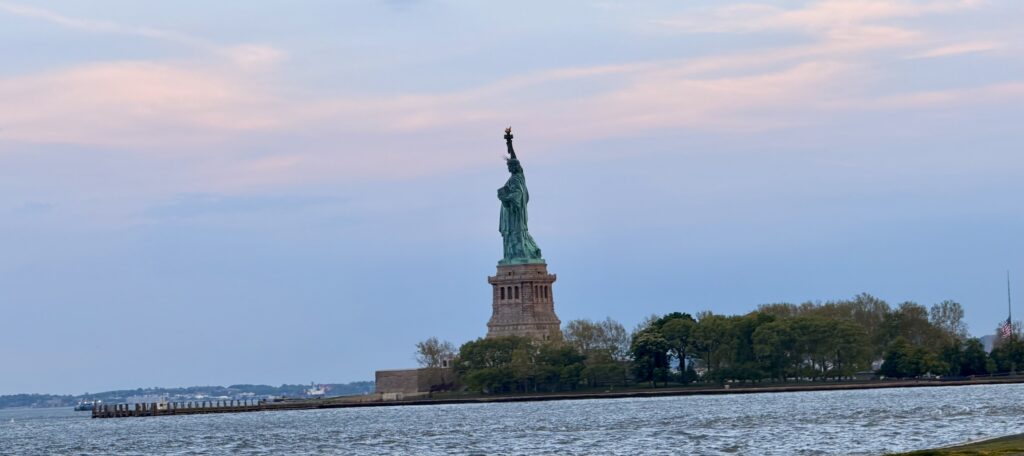
I was standing on Ellis Island last night, celebrating friends who were receiving the 2026 Ellis Island Medal of Honor, and I could not stop looking at her.
Lady Liberty. Standing there in the harbor the way she has for 140 years, torch raised, crown gleaming. We all know her. We have all seen her image a thousand times. She is the most recognizable symbol of freedom on the face of the earth.
But most Americans — and I mean most — do not know the real story of how she came to be. And almost nobody knows the story of what she was originally designed to say, and to whom she was originally designed to speak.
This is the story they never taught us in school. And it is a story I believe we need now more than ever.
It begins not in New York, but in France. Not with immigration, but with abolition.
In 1865 — the very year the Civil War ended and the 13th Amendment abolished slavery in the United States — a French political thinker named Édouard de Laboulaye sat down with a sculptor named Frédéric Auguste Bartholdi and proposed a radical idea: that France should gift a great monument to the United States, celebrating not only the centennial of American independence but the end of slavery on American soil.
This was not incidental to the idea. It was central to it.
Laboulaye was president of the French Anti-Slavery Society. He was a constitutional scholar, deeply admired Abraham Lincoln, and had been a fierce supporter of the Union cause. He co-founded an organization that raised money for newly freed slaves in America. For Laboulaye, the passage of the 13th Amendment was the fulfillment of a promise — the moment when the words “all men are created equal” began, at last, to mean what they said.
The statue was his way of honoring that moment.
Here is what makes this story extraordinary — and what has been suppressed, overlooked, or quietly buried for more than a century.
Bartholdi’s earliest designs for the statue depicted Lady Liberty holding broken chains and shackles in her left hand. The symbolism was unmistakable. This was not a vague nod toward “freedom” in the abstract. This was a monument to emancipation. To the breaking of bonds. To the end of the most brutal system of human exploitation in the modern world.
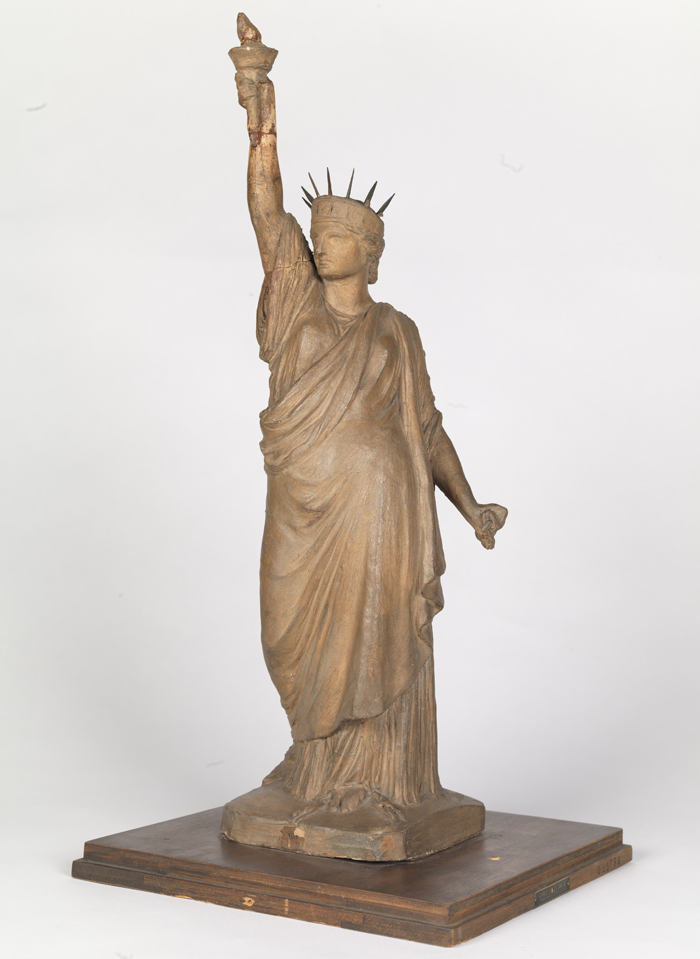
And there is compelling evidence, documented in French records and discussed by scholars for decades, that Bartholdi’s earliest sketches drew on the image of a Black woman — possibly inspired by his earlier work on a proposed colossal monument for Egypt, for which he had used drawings of Egyptian women as models. A roughly 19-inch terra-cotta maquette attributed to Bartholdi, dating to approximately 1870, sits today in the Museum of the City of New York. It shows a figure holding what appears to be a broken shackle in her hand, with chains emerging from beneath her robes.
Some historians have debated the specifics of these early models. But what is not debated — what is now acknowledged by the National Park Service itself on its own website — is that the Statue of Liberty was born from the abolitionist movement, conceived by abolitionists, and designed with the explicit intention of commemorating the end of slavery in America.
So what happened?
Money happened. Politics happened. The same forces that always seem to intervene when the truth about Black freedom gets too close to the surface.
As the project moved forward, American financiers — the men who were being asked to fund the pedestal upon which the statue would stand — grew uncomfortable with the overt references to slavery and emancipation. Some of these men had built their fortunes directly or indirectly through the very system the statue was designed to memorialize the end of. The chains in Liberty’s hand were considered too divisive. Too provocative. Too Black.
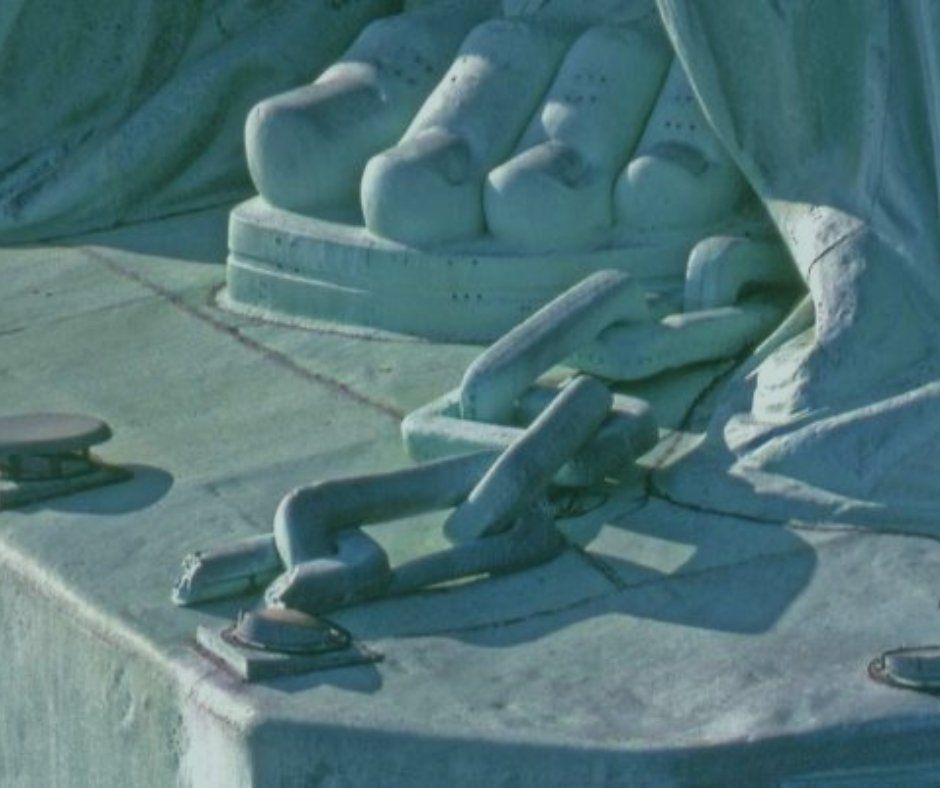
So Bartholdi, under pressure, made a decision. He removed the broken chains from Liberty’s left hand and replaced them with a tablet inscribed with the date of the Declaration of Independence — July 4, 1776. He moved the chains to her feet, where they would be hidden beneath the folds of her robes, barely visible from the ground, 305 feet below.
And there they remain to this day. Broken chains and a broken shackle, lying at the feet of the most famous statue in the world, seen by almost none of the 4.5 million people who visit her every year.
The truth, hidden in plain sight.
By the time the statue was dedicated on October 28, 1886, its message had already begun to shift. The abolitionist origins were being quietly replaced with a safer, more comfortable narrative — one about European immigration and “universal liberty.” The story of Black freedom, the very story that had inspired the statue’s creation, was being written out of the record.
And Black Americans noticed.
Shortly after the dedication, the Cleveland Gazette, one of the nation’s leading Black newspapers, published an editorial that could have been written yesterday. It said, in essence: do not celebrate this statue while Black men and women in the South are being terrorized, murdered, and denied their basic rights. The promise of those broken chains had not been kept.
W.E.B. Du Bois later wrote that when he sailed past the Statue of Liberty on a return trip from Europe, he could not summon the hope that he imagined European immigrants might feel at the sight of her. That hope, he understood, was not meant for people who looked like him.
Then in 1903 — seventeen years after the statue’s dedication — Emma Lazarus’s poem “The New Colossus” was affixed to the pedestal. “Give me your tired, your poor, your huddled masses yearning to breathe free.” Beautiful words. Iconic words. But words that completed the transformation. Lady Liberty became, in the American imagination, a symbol of immigration. Her abolitionist origins were buried so deep that most Americans have never heard of them.
I am telling you this story because I stood on Ellis Island last night and I felt it.
I felt the weight of the fact that I was standing in the Great Hall where twelve million immigrants once arrived in America clutching their papers and their dreams — and across the water stood a statue that was originally built to celebrate the freedom of people who looked like me. People whose ancestors did not arrive on these shores clutching dreams. They arrived in chains.
And the chains that were supposed to be held high in Lady Liberty’s hand — a declaration to the world that America had broken those bonds — were moved to her feet, out of sight, because the truth was too uncomfortable for the people writing the checks.
If that is not a metaphor for the American experience with race and economics, I do not know what is.
But here is why I am ultimately hopeful, and why this story matters right now.
The chains are still there.
Bartholdi fought to keep them. He could not keep them in her hand, but he refused to remove them entirely. He placed them at her feet — broken — so that anyone who cared enough to look would find the truth. And today, the National Park Service tells this story openly on its website. Scholars, educators, and historians are bringing it into the light. The truth has a stubborn way of resurfacing.
And that is what I believe about the larger American story. The promise of this country — the promise that free enterprise, opportunity, and dignity belong to everyone — has been deferred, delayed, diluted, and buried more times than I can count. But it has never been destroyed. It keeps resurfacing, because it is true.
That is what I write about in Capitalism for All. That is what we work toward every day at Operation HOPE, Inc. Not charity. Not handouts. The completion of an unfinished promise. The promise that was etched into the idea of a colossal woman, standing in a harbor, holding broken chains aloft for the world to see — before those chains were quietly moved to her feet.
One day, I believe, we will move them back.
Let’s go.
John Hope Bryant — founder of Bryant Group Ventures, Operation HOPE, Inc, publisher of the Bryant Journal and author of his 7th book Capitalism for All: Inclusive Economics and the Future Proofing of America, now a bestseller. Bryant was recently named a member of the Forbes 250.