A conversation with Marshall University President Brad D. Smith — and a lesson a century in the making
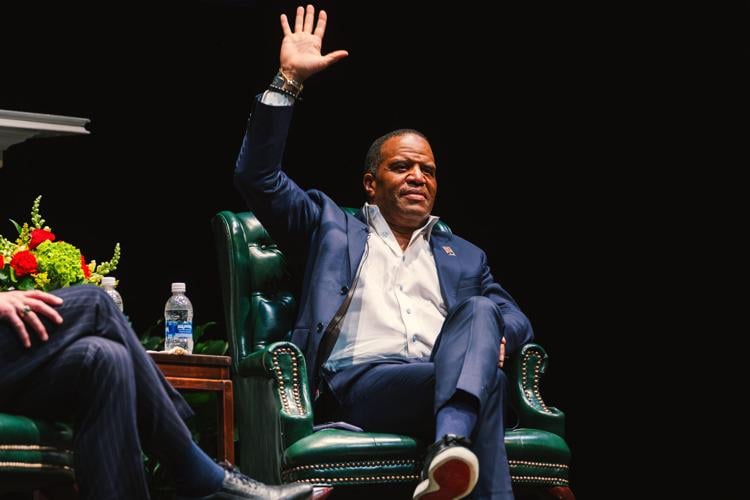
There are moments when history, geography, and purpose converge in ways that feel less like coincidence and more like calling.
Last week, I had one of those moments.
I was invited to Marshall University in Huntington, West Virginia — the state of my wife Chaitra Dalton Bryant and my friend Bishop T.D. Jakes‘ birth I might add — and to speak during the 100th anniversary celebration of Black History Month, originally conceived by Carter G. Woodson as Negro History Week in 1926. What most people don’t know — and what made standing on that stage feel almost sacred — is that Carter G. Woodson was a West Virginian. He worked in the coal mines of this state as a young man before pursuing an education that would eventually take him to Harvard, where he became only the second Black American to earn a doctorate. West Virginia shaped him. And in return, he helped shape America’s conscience.
It was the perfect place to have this conversation.
When I arrived at Marshall University, I was greeted by Mrs. Alys Smith — warm, gracious, and kind enough to personally walk me in to meet her husband, Marshall University President Brad D. Smith. That gesture said everything. This was not a transactional engagement. This was friendship. And it is.
Brad D. Smith is one of the most consequential institution-builders working in America today. What many don’t yet know is that Brad and Alys made a commitment — together, as a family — to become founding one-million-dollar members of the Operation HOPE, Inc. 1865 Project, seeding our financial empowerment work across West Virginia. That is not a symbolic gesture. That is a founding family investment in the belief that economic dignity is possible for every community, in every zip code, including those that have long been told to wait their turn.
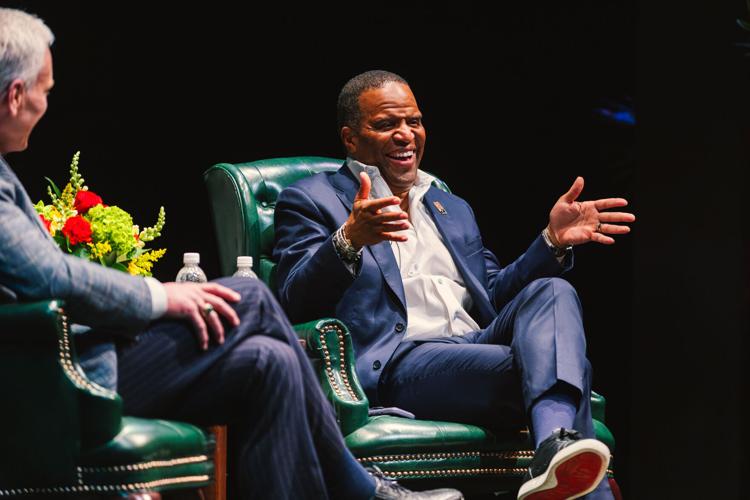
The fireside chat Brad and I shared that evening ranged across territory both personal and urgent — my early life in Compton, the meaning of financial literacy in an AI-driven economy, and what it will take to build a genuine prosperity platform for a region whose resilience has never been in question, but whose access to capital and opportunity long has been.
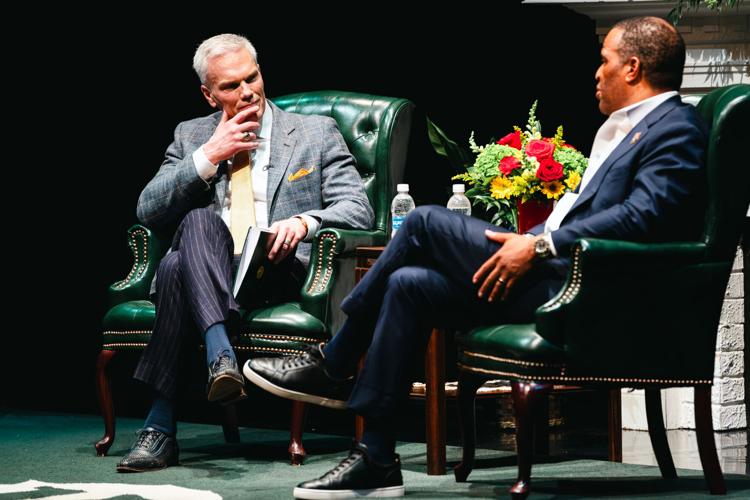
That conversation, and that place, stayed with me. Because the questions Brad and I explored in Huntington are the same questions at the heart of my piece now published in TIME magazine — and at the heart of my forthcoming book, Capitalism for All.
The TIME piece is about Carter G. Woodson. But it is really about us. About America at 250. About whether we are bold enough to tell a story large enough to include everyone, and build an economy strong enough to draw on the full genius of all our people. Woodson understood that narrative is infrastructure. That the stories a nation tells about itself determine who gets built in — and who gets written out. A century after he launched what became Black History Month, that lesson feels more urgent, not less.
Capitalism for All carries that argument forward. Because the issue was never capitalism itself — it was access to it. Billions of people globally, and tens of millions of Americans, have been operating outside the system, or on its margins — not because they lack talent or drive, but because no one ever handed them a real invitation in. The coming AI economy will not fix that automatically. It will either widen that gap or close it — and the difference will come down to choices we make right now, in this window, before the architecture is set.
What I witnessed in Huntington is proof that those choices can go the right way. Brad and Alys Smith have made a real bet on their community. Operation HOPE, Inc. financial coaches are sitting across tables from real people every day — helping them move from financial fragility to financial dignity, one credit score and one conversation at a time. That is not charity. That is strategy. That is Woodson’s blueprint in action. That is, in the most practical sense, capitalism for all.
Woodson gave us the framework a century ago, standing on West Virginia ground. Brad and Alys Smith are building it in real time, on that same ground today. And with Capitalism for All, I hope to hand the next generation a roadmap that makes this work not the exception — but the rule.
The fire side chat was covered by WSAZ and Herald Dispatch and Parthenon.
Read the full TIME piece here: time.com/7380942/us-250-anniversary-carter-g-woodson
John Hope Bryant — founder of Bryant Group Ventures, Operation HOPE, Inc, publisher of the Bryant Journal and author of his coming book Capitalism for All: Inclusive Economics and the Future Proofing of America.