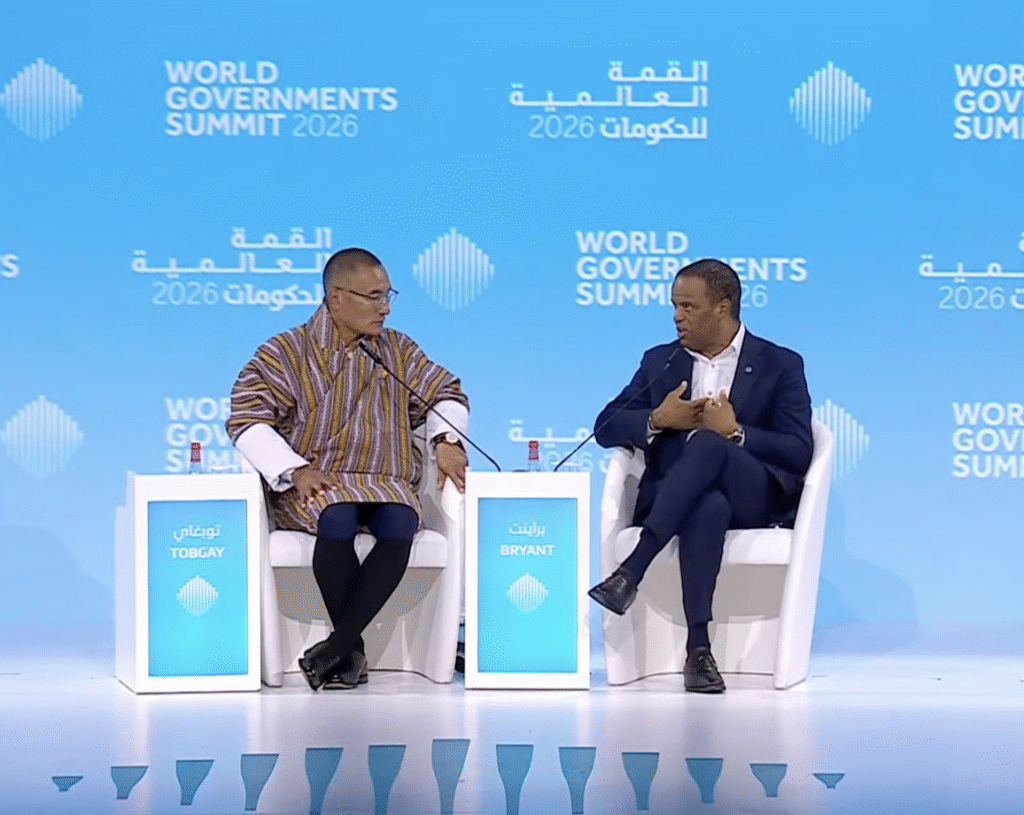
At the World Governments Summit in Dubai, I had the honor of sitting down with His Excellency Tshering Tobgay, Prime Minister of the Kingdom of Bhutan, for a conversation centered on a powerful question:
What should governments actually optimize for?
GDP? Growth? Markets?
Or something deeper.
What struck me immediately about Bhutan and its leadership is that they’ve made a deliberate choice. While much of the world has optimized for economic output alone, Bhutan has optimized for human well-being.
Their guiding philosophy is called Gross National Happiness.
Not as a slogan.
As policy.
In Bhutan, progress is measured not only by economic growth, but by:
- Health and education
- Environmental conservation
- Cultural preservation
- Good governance
- Community and psychological well-being
This is a country that is carbon negative, environmentally resilient, culturally grounded, and increasingly forward-looking.
And they’re not stopping there.
The Prime Minister shared the vision for the Gelephu Mindfulness City—a new special administrative region designed from the ground up to integrate capitalism, sustainability, spirituality, technology, and human flourishing.
In other words: growth with purpose.
This conversation reinforced something I have long believed:
The future belongs to societies that can do well economically while also doing good for their people.
Bhutan offers a compelling model, not because it is the largest economy, but because it is asking one of the most important questions of our time:
What is the purpose of growth if it does not improve human life?
I invite you to watch the full conversation and hear directly from the Prime Minister about Bhutan’s vision and why this moment represents an opportunity, not just for Bhutan, but for the world.
Click here to watch the full discussion
And as always, I’d love to hear your thoughts.