The latest jobs report carries a warning most Americans will miss.
Black unemployment has climbed to its highest level since 2021 — hovering around 7 percent — nearly double the unemployment rate for white Americans and significantly above the national average, which remains closer to 4 percent.
Let me translate that.
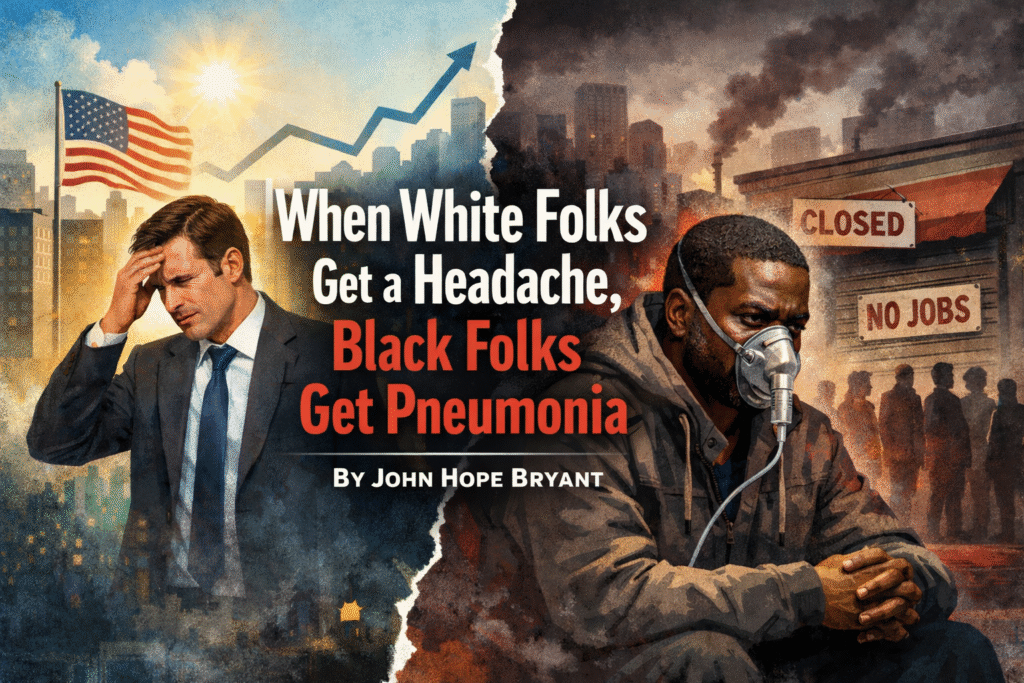
When white folks get a headache, Black folks have pneumonia.
This is not rhetoric. It is economic pattern recognition.
For decades, Black unemployment has functioned as America’s early warning system. When the broader labor market softens, Black workers feel it first. When hiring slows, they are often last hired and first fired. When uncertainty enters the system, communities already closest to the edge absorb the shock. One could say that Black America is the ‘canary in the coal mine.’ The early warning system for America’s economic health.
And here is the part that should concern everyone: this is not just a Black issue.
It is a national competitiveness issue.
It is a growth issue.
It is a capitalism issue.
The Tale of Two Labor Markets
On paper, the U.S. labor market still looks stable. The headline unemployment rate remains historically moderate. But beneath that headline is a different story.
A roughly 7 percent Black unemployment rate alongside a 4 percent overall rate means millions of Americans are living in what feels like a recession inside of an expansion.
That divergence tells us something profound: we are not fully utilizing our human capital.
You cannot claim economic excellence while a major segment of your workforce is twice as likely to be unemployed. That is not random fluctuation. That is structural fragility.
And fragility anywhere eventually becomes instability everywhere.
When participation gaps persist, productivity gaps follow. When productivity gaps widen, GDP underperforms. When GDP underperforms, everyone feels it.
Inclusive growth is not charity. It is strategy.
The Pneumonia Problem
The metaphor matters because it reveals structural vulnerability.
If you have six months of savings, a job loss is painful but survivable.
If you have three weeks of savings, a job loss is destabilizing.
If you have three days of savings, a job loss is catastrophic.
Because of historic exclusion from wealth-building systems — from land ownership to GI Bill access to redlined mortgages to unequal access to capital — many Black households still operate with thinner financial cushions. Lower average household wealth means less room to absorb economic shocks.
So when unemployment ticks up slightly in the broader economy, it doesn’t land evenly.
It concentrates.
And concentrated pain becomes concentrated instability.
This is why the unemployment gap is not just a labor statistic. It is a balance sheet issue. It is a resilience issue.
And in a nation preparing for AI disruption, automation, and global competition, resilience matters.
Capitalism for All — Or Growth for Few?
In my upcoming book, Capitalism for All, I argue that America’s future depends on broad participation in wealth creation.
Not redistribution.
Participation.
Ownership.
Productivity.
When unemployment among Black Americans rises to nearly double the national average, we are witnessing under-participation in the American economic engine.
That means:
• Fewer first-time homebuyers
• Fewer small business launches
• Lower consumer spending in key communities
• Less intergenerational wealth transfer
• Reduced tax base growth
Every percentage point of sidelined talent represents lost output. Economists have long argued that closing racial employment gaps would add billions — even trillions over time — to long-term U.S. GDP. And in doing, this can move to reduce the deficit too.
The question is not whether we can afford inclusive growth.
The question is whether we can afford not to pursue it.
This Is Not About Blame
It is about architecture.
If one group consistently experiences unemployment at nearly twice the rate of another, that signals structural misalignment — in access to networks, skills pipelines, capital, and opportunity.
And if that misalignment persists, it breeds cynicism.
Cynicism erodes trust.
Eroded trust weakens social cohesion.
Weak social cohesion undermines economic dynamism.
The ladder must be sturdy for everyone, or eventually no one climbs securely.
What Must Happen
We need to move from symbolic inclusion to systemic inclusion.
That means:
• Scaling skills training aligned with future industries
• Expanding access to capital for entrepreneurs
• Improving credit score mobility and financial literacy
• Strengthening public-private partnerships around workforce pipelines
• Moving more Americans from job-seeker to job-creator
This is not about equal outcomes. It is about expanding equal access to opportunity.
Because capitalism works best when the maximum number of people are climbing.
Not sitting out.
Not locked out.
Climbing.
An Early Warning Signal
Black unemployment at its highest level since 2021 should not be dismissed as a temporary fluctuation.
Historically, the Black unemployment rate has often deteriorated before broader recessions take hold. That makes it not just a moral concern — but an economic indicator.
If we ignore that signal, we do so at our own risk.
America does not need a protective economy that walls people out.
America needs an inclusive one that brings people in.
If we want stronger growth, more stability, and global competitiveness, we must ensure that every striving American is fully actualized.
When white folks get a headache, nobody else should be fighting for breath.
Capitalism for All is not a slogan.
It is an economic imperative.
And the data is telling us — again — that it is urgent.

John Hope Bryant — founder of Bryant Group Ventures, Operation HOPE, Inc, publisher of the Bryant Journal and author of his coming book Capitalism for All: Inclusive Economics and the Future Proofing of America.