The day after Americans vote, Congressman Ro Khanna and I will sit down in the heart of Silicon Valley to talk about the question elections alone can’t answer: who gets to participate in the economy we’re building?
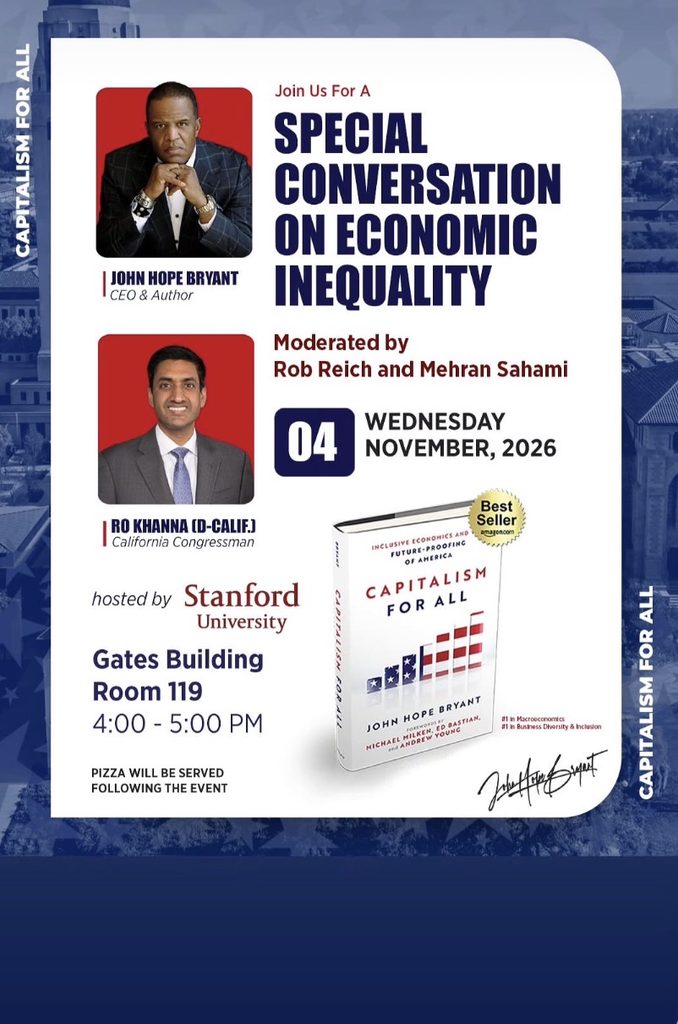
Tomorrow afternoon, I’ll walk into Room 119 of the Gates Computer Science Building at Stanford University to talk about what I believe is the defining economic question of our time: not how much wealth America can create, but how many Americans get to take part in creating it.
I’ll be joined by Congressman Ro Khanna, who represents Silicon Valley in the U.S. House, for a special conversation on economic inequality hosted by Stanford. Our moderators are two of the university’s most respected voices on technology and society, Professors Rob Reich and Mehran Sahami.
The timing is not lost on me. Today, Americans go to the polls. Tomorrow, whatever the results, the country wakes up with the same unfinished business it had the day before: a middle class under strain, young people who wonder whether the economic ladder is still there, and a technological revolution moving faster than our institutions can absorb it. Elections decide who governs. They do not, on their own, decide who prospers. That work belongs to all of us, every day after the ballots are counted.
Why this room matters
The location isn’t incidental. The Gates Building is where generations of Stanford computer scientists have learned to build the technologies that now run the world. Some of the most consequential companies of the digital age trace their roots to the classrooms and labs on this campus. Congressman Khanna has often pointed out that the companies in and around his district represent trillions of dollars in market value.
That is extraordinary wealth creation. It is also an extraordinary responsibility. Because not far from any center of prosperity in this country, there are families who have never been shown how a credit score works, never had a relationship with a bank, and never been invited into the economy being built down the road. I know those families. I grew up in one. Growing up in Compton and South Central Los Angeles, I never saw a banker in my neighborhood.
Operation HOPE exists because of that gap. Over more than three decades, we have helped direct more than $5 billion in economic activity into underserved communities, not through handouts, but through hand-ups: financial literacy, credit building, small business ownership and homeownership. That is what I mean by Silver Rights, the economic chapter of the civil rights movement.
Two capitalists in the room
Here is what gives me hope about tomorrow. Congressman Khanna and I come at this work from different places. He is a legislator. I am a businessman who has worked with presidents of both parties. But we have arrived at strikingly similar conclusions.
In his book Dignity in a Digital Age, later published as Progressive Capitalism, he argues that no American should have to move to Silicon Valley to share in the digital economy. In Capitalism for All, I argue that inclusion is not charity. It is a competitive advantage, and the surest way to future-proof America. Neither of us is calling to tear capitalism down. Both of us are calling to open it up.
That matters, because too much of our national debate on inequality has become a shouting match between those who believe the system is broken beyond repair and those who believe it needs no repair at all. I reject both positions. America does not need less capitalism. America needs more people prepared to participate in capitalism.
“Elections decide who governs. They don’t decide who prospers. That part is on all of us.”
What I’ll bring to the conversation
Professors Reich and Sahami co-wrote System Error and co-teach Stanford’s course on ethics, public policy and technological change. They have spent years asking the people who build technology to consider who it serves. I expect them to press us, and they should. Here is what I intend to put on the table.
AI will be the great divider or the great equalizer. Artificial intelligence will create enormous wealth. That isn’t in doubt. What is in doubt is whether the workers and communities most exposed to disruption will be equipped to participate in that wealth. That’s the work of the AI Ethics Council, which I co-chair with Sam Altman, and it has to be the work of every engineer in that building.
Financial literacy is the missing infrastructure. You cannot democratize capital that people don’t understand. Before we argue about redistribution, we should make sure every young American knows how money, credit and ownership actually work.
A strong middle class is national security. An economy where most people feel locked out is not stable, no matter how high the stock market climbs. Expanding the middle class is not a soft goal. It is a strategic one.
The students are the most important people in the room. They will write the code, start the companies and run the institutions of the next 30 years. If they leave asking “Who is this for?” about everything they build, it will have been a very good afternoon.
The work after the vote
I am grateful to Stanford University, to Professors Reich and Sahami, and to Congressman Khanna for making room for this conversation at such a consequential moment. And yes, there will be pizza afterward. Some of the best conversations about the future happen over a slice.
If you are on campus, join us in Gates Room 119 at 4:00 p.m. If you can’t be there, I’ll share what we learned right here in The Bryant Journal.
Capitalism for all. Not some. All.
John Hope Bryant
John Hope Bryant — founder of Bryant Group Ventures, Operation HOPE, Inc, publisher of the Bryant Journal and author of his 7th book Capitalism for All: Inclusive Economics and the Future Proofing of America, now a bestseller. Bryant was recently recognized as a member of the Forbes 250 Greatest Living Self Made Americans, on the occasion of the 250th anniversary of America itself. Get the book →
#CapitalismForAll #BryantJournal #Stanford #EconomicInequality #InclusiveEconomics #FinancialLiteracy #SilverRights #OperationHOPE #AI