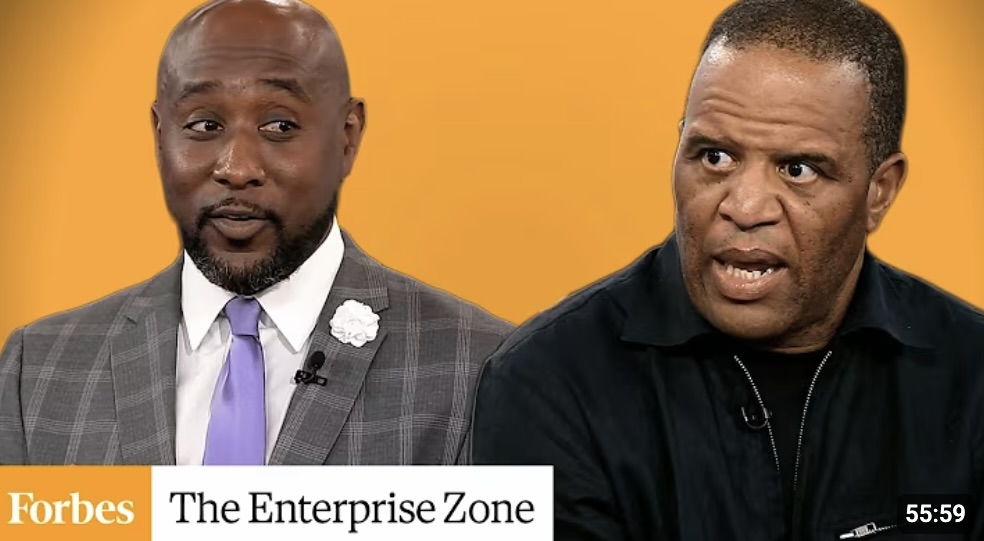
On this episode of The Enterprise Zone, CEO of Operation HOPE John Hope Bryant sat down with Forbes to discuss financial literacy, economic sentiment, and his $1 billion affordable housing impact fund launched alongside CIM Group. Bryant is the CEO of Bryant Group Ventures and discussed his inclusion on Forbes’s 250 Greatest Living Self-Made Americans list, stakeholder capitalism models like profit-sharing, and updates his organization’s 1 Million Black Businesses initiative with Shopify.
THE BRYANT JOURNAL | ON FORBES’ THE ENTERPRISE ZONE
The System Isn’t Broken.
It Just Needs a Better Plumber — On Housing, Stakeholder Capitalism, and the Silver Rights Movement
By John Hope Bryant | Founder, Chairman & CEO, Operation HOPE, Inc. | Founder & CEO, Bryant Group Ventures
“Financial literacy is the civil rights issue of this generation. If we don’t fix the pipes, it doesn’t matter how much water we pour into the system.”
I sat down recently with Forbes senior writer Jabari Young at the Nasdaq MarketSite for an episode of The Enterprise Zone, and I walked away from that conversation more convinced than ever that we are at an inflection point — not just for the economy, but for how this country defines opportunity itself.
You can watch the full conversation here, and I want to use this space to unpack a few of the threads we pulled on, because each one connects to the same throughline: capitalism has to work for everybody, or it will not work for anybody — including the people who currently think it’s working just fine for them.
A Billion Dollars, Aimed at the Housing Crisis
We talked at length about the affordable housing fund I’ve built alongside CIM Group and Avi Shemesh — a fund with the ambition to scale toward $1 billion in capacity, with KeyBank, Truist, and Flagstar already at the table as investors. This is not charity. This is capital, deployed with discipline, aimed at one of the most stubborn barriers to wealth-building in America: the widening gap between what working families earn and what a place to live actually costs.
Homeownership has always been the on-ramp to the American Dream. When that on-ramp narrows, the whole economy slows down with it — not just for renters, but for the builders, the lenders, the small businesses on Main Street who depend on stable, rooted communities. An economic plumber doesn’t just talk about the leak. He goes and fixes the pipes. That’s what this fund is built to do.
Stakeholder Capitalism Isn’t a Slogan — It’s a Business Model
Jabari and I also got into a conversation I care deeply about: the shift from shareholder-only thinking toward stakeholder capitalism — profit-sharing models where the employees closest to the value creation actually share in the value they help create. I’ve said it before and I’ll keep saying it: the most successful companies of the next fifty years will be the ones who understand that a thriving workforce and a thriving balance sheet are not competing goals. They are the same goal, viewed from two different windows.
The Forbes 250 — and What It Actually Means
We also discussed my inclusion on the Forbes 250 Greatest Living Self-Made Americans list, released on the occasion of our nation’s 250th anniversary. I don’t take that lightly, and I don’t take it personally either — I take it as proof of concept. A kid raised in Compton and South Central Los Angeles, raised by a mother who worked with her hands, ends up on a list like that not because the system bent the rules for him, but because enough people — mentors, believers, bankers willing to take a chance — decided to build a bridge instead of a toll booth. That’s the whole thesis of Capitalism for All in one sentence.
One Million Black Businesses — The Numbers Keep Climbing
Finally, I gave Jabari an update on where we stand with the 1 Million Black Businesses initiative, our partnership with Shopify now years into building small business capacity in underserved communities across the country. Every business we help launch or scale is a family that doesn’t need government assistance to make it — it’s a household that’s been converted from checking a box marked “need” to checking one marked “contribute.” That’s the whole game.
Financial literacy is the civil rights issue of this generation. We die for lack of knowledge — not lack of opportunity. My job, and the job of everyone at Operation HOPE, is to build more bridges, and less toll bridges, so that opportunity actually reaches the people who’ve been locked out of it the longest.
Watch the full conversation on Forbes’ The Enterprise Zone, and let me know what stood out to you.
Let’s go.
John Hope Bryant — founder of Bryant Group Ventures, Operation HOPE, Inc, publisher of the Bryant Journal and author of his 7th book Capitalism for All: Inclusive Economics and the Future Proofing of America, now a bestseller. Bryant was recently recognized as a member of the Forbes 250 Greatest Living Self Made Americans, on the occasion of the 250th anniversary of America itself. Get the book →
#FinancialLiteracy #SilverRights #StakeholderCapitalism #AffordableHousing #InclusiveCapitalism #OperationHOPE #BryantGroupVentures #CapitalismForAll #Forbes250 #1MillionBlackBusinesses