Every year, I choose one word. Not a resolution. Not a hashtag. A word — something that captures the assignment in front of us and demands that we grow into it.
Last year, we built. The year before that, we scaled. And now — now — we have arrived at the most important word in the life of any movement, any mission, any organization that intends to outlive the founder.
The word for 2026 is Institutionalization.
I know. It’s a long word. It’s an uncomfortable word. But uncomfortable words are often the most important ones. So sit with me for a moment.
From Persona to Permanence
I have watched too many powerful movements die with the person who started them. I have watched brilliant ideas that changed lives dissolve into memory the moment the founder left the room — or left the earth. And I have asked myself, again and again: Why?
The answer is always the same. They never made the leap from personality to institution.
Here’s how I describe the journey every great organization must take. You start with persona and personality — it’s your passion, your hustle, your story that gets people to believe. Then you move to pilot program — you prove the concept works. Then come the proof points — results, data, lives changed. Then performance — you scale it and sustain it.
But the final stage — the hardest stage — is this one. Institutionalization. That is where you go from what I can do to what we will always do, with or without me standing in the room.
What It Really Means
Institutionalization is not about becoming cold or bureaucratic. It is not about trading your soul for a spreadsheet. It is about love — the kind of love that plans ahead. The kind of love that says: I care enough about this mission to make sure it survives me.
A great institution is a system that can wake up when you don’t — and still do the right thing well. It’s a culture so embedded, so disciplined, so principled, that nobody even notices when the founder stepped away, because the work continues just the same.
Think about the institutions that shaped this country. Think about the universities, the churches, the great hospitals, the civic organizations that have served communities for 100 years or more. They didn’t survive on charisma. They survived on infrastructure — on values written down, on processes honored, on leadership developed from within, on boards that held the mission accountable when the moment got hard.
That is what we are building now.
This Is Personal
Let me be honest with you, as I always am in this journal.
When I founded Operation HOPE after the 1992 Los Angeles riots — as a 26-year-old kid from Compton who had no business starting a nonprofit — it was pure personality. It was passion. It was pain turned into purpose. And that was exactly what was needed in that moment.
But a moment cannot become a movement unless you build something bigger than yourself.
We have now provided more than $4 billion in economic resources to underserved communities. We have financial literacy coaches inside bank branches across America. We have shaped federal policy. We are a permanent part of the Smithsonian. That did not happen because of me alone. It happened because extraordinary people joined this mission and we started building systems — real systems — that could carry the work forward.
2026 is the year we deepen that work. Not just at Operation HOPE. But in every organization I am connected to. And I want to challenge every leader reading this to do the same.
The Challenge I’m Laying Down
If you are a founder — of a business, a nonprofit, a community organization, a family legacy — I need you to ask yourself some hard questions in 2026:
Does your organization have a life independent of your presence? If you walked out the door today and didn’t come back for six months, would the mission continue? Would the culture hold? Would the right decisions still get made?
Have you built systems or just habits? Habits live in one person. Systems live in the organization. Do you have documented processes, trained leaders at every level, and boards or advisors who will hold the mission accountable when things get hard?
Are you developing other leaders, or just followers? The most dangerous thing a leader can do is surround themselves with people who only know how to execute what they are told. The mark of a great institution is that it produces other great leaders.
Have you written it down? Your values. Your decision-making framework. The non-negotiables. The things that are never for sale, no matter what. If it’s only in your head, it will die with you.
This Is How We Win Long
I have said for years that I am not in the business of charity. I am in the business of economic dignity — and dignity is not a program. Dignity is a birthright. And birthrights have to be protected by institutions.
The civil rights movement gave us laws. But laws only hold when institutions enforce them, when communities demand them, when organizations are strong enough to fight for them generation after generation. We need to build those organizations.
We are living in a moment of tremendous disruption — artificial intelligence, economic inequality, political uncertainty, shifting global power. In this environment, the organizations that will survive and serve are not the ones with the most charismatic leaders. They are the ones with the deepest roots.
2026 is the year we put our roots down.
Not because the work of inspiration is done. But because inspiration without infrastructure is just a dream. And our people — the people who need financial literacy, economic opportunity, a real shot at the American Dream — they deserve more than a dream. They deserve an institution that will fight for them tomorrow, just as fiercely as we fight for them today.
A Final Word
I want to leave you with this.
Every morning in Africa, a gazelle wakes up. It knows it must run faster than the fastest lion, or it will be killed. Every morning, a lion wakes up. It knows it must outrun the slowest gazelle, or it will starve. It doesn’t matter whether you are a gazelle or a lion — when the sun comes up, you better be running.
We have been running for 30 years. And we are still running. But now, in 2026, we are not just running — we are building the road for those who will run after us.
That is the work of institutionalization. That is the word of this year. That is the assignment.
Let’s get to work.
With love, purpose, and possibility —
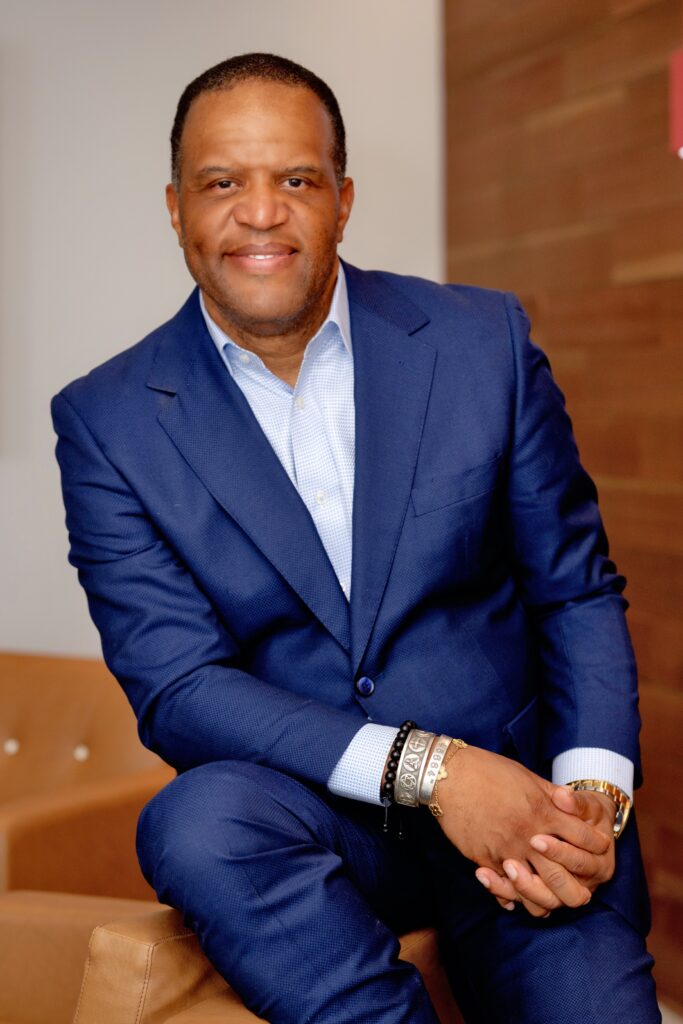
John Hope Bryant — founder of Bryant Group Ventures, Operation HOPE, Inc, publisher of the Bryant Journal and author of his coming book Capitalism for All: Inclusive Economics and the Future Proofing of America.
The Bryant Journal — 2026