A Bryant Journal Foundations piece
Ask ten people to define poverty and nine of them will give you a number. A line on a government chart. An income threshold, adjusted for family size, updated once a year by people who have never had to live under it.
I am not an economist. I don’t hold a degree in economics, and my newest bestseller, ‘Capitalism for All,’ is not an economics textbook. But I have spent more than three decades in the offices of Operation HOPE, sitting across the table from people the numbers were supposedly describing, and I can tell you: the number is not wrong, exactly. It is just not the point.
If you have around 9 broke people, you will likely be the 10th…
From John Hope Bryant’s ‘Straight Talk Live’ Video Series
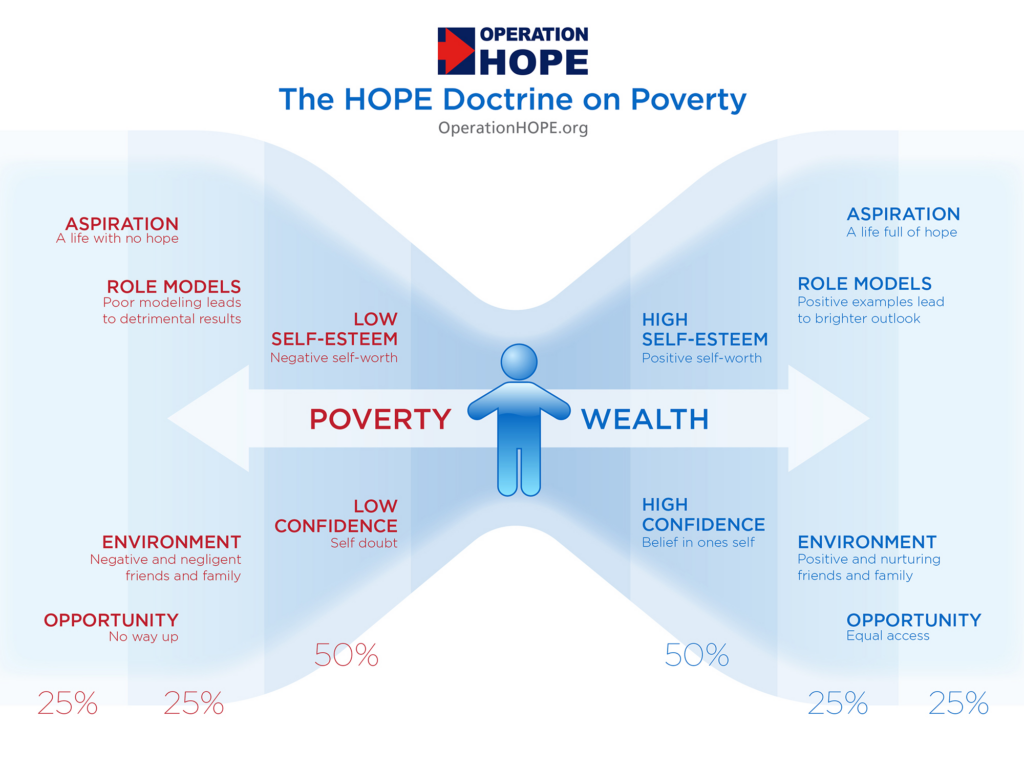
So years ago, I set out to redefine poverty in terms that actually matched what I was seeing. I call it the HOPE Doctrine on Poverty, and it says that poverty is made of three things — none of which show up on a government spreadsheet.
The first is self-confidence, self-esteem, self-belief — or the absence of it.
In this country, if you wake up in the morning and you don’t know who you are, by dinnertime someone will tell you. That is not a threat. It is just how it works. A person without a settled sense of their own worth is a person waiting to be defined by somebody else’s opinion of them, and that opinion is rarely generous. If you don’t like yourself, you cannot really like anyone else. If you don’t respect yourself, you have no template for respecting others. This is where poverty actually starts — not in the wallet, but in the mirror.
The second is role models, and environment.
Everyone is aspirational. Everyone. Nobody wakes up wanting to fail. The problem is that people model what they see, not what they’re told. If the only visible symbols of success in your neighborhood are the drug dealer, the athlete, and the rap star, you are not being irrational when you aim for one of the three. You are being perfectly rational, based on the evidence in front of you. That is not a character flaw. That is math.
I have a simple way of putting this: if you hang around nine broke people, you will likely be the tenth. If you grow up around nine nuclear scientists, you will likely be the tenth of those, too. Environment is not destiny, but it is gravity. It pulls, whether you notice it or not.
The third is opportunity.
If you don’t have the chance to actually put your talent to work — your smarts, your education, your work ethic — then life has a concrete ceiling instead of a glass one. You cannot see through it, and eventually you stop trying to. That is where hope dies. And the most dangerous person in the world is a person without hope, because a person without hope has nothing left to lose, and nothing left to lose is not a stable place for a society to keep large numbers of its own people.
Put those three together — confidence, environment, opportunity — and you have a truer definition of poverty than any income line has ever given us. It also happens to be a more useful one, because unlike a number on a government chart, every part of it is something we can actually build.
I want to be direct about why this doctrine has nothing to do with socialism. Ninety-two percent of jobs in this country come from the private sector. Even the most committed command economies on Earth have had to make room for capitalism to function at all. Capitalism is a terrible system — except for every other one. My argument was never that we should tear the system down. My argument is that no one had ever seriously tried to make the system work for the poor, and the left-out, and the left-behind, at real scale. So I decided to try.
I think about this as harvesting in the plot of the poor. Not extracting from it — harvesting it, the way you’d tend a garden that belongs to someone else, with respect for the fact that it is theirs. The talent is already there. The instinct to build, to hustle, to provide — I have watched it in every underserved community I have ever worked in. What is usually missing is not character. It is capital, confidence, and a clear line of sight to something better than what’s currently in view.
This doctrine is the floor everything else I have built stands on. You cannot design a solution to a problem you have defined wrong. Get the definition right, and the solution starts to write itself — which is exactly where the HOPE Doctrine on Wealth picks up the thread.
Define the problem honestly. Then go to work on it. That has always been the assignment.
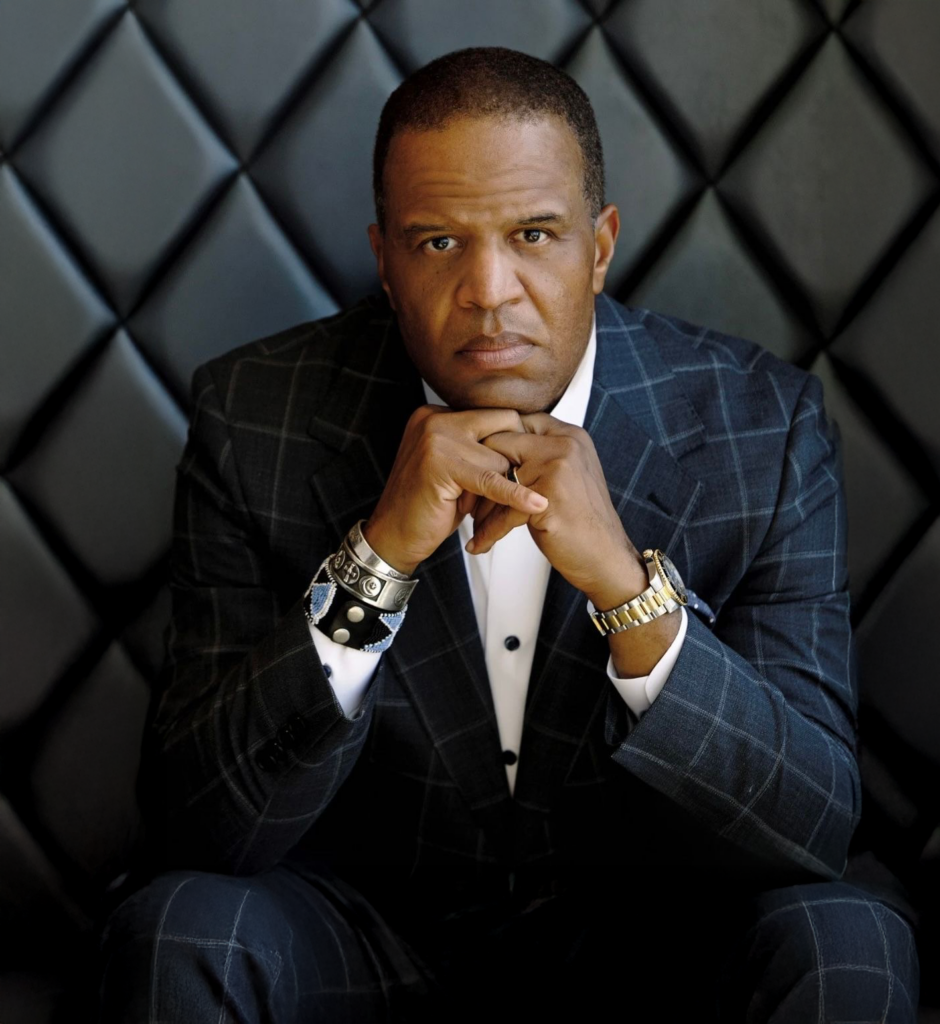
John Hope Bryant — founder of Bryant Group Ventures, Operation HOPE, Inc, publisher of the Bryant Journal and author of his 7th book Capitalism for All: Inclusive Economics and the Future Proofing of America, now a bestseller. Bryant was recently recognized as a member of the Forbes 250 Greatest Living Self Made Americans, on the occasion of the 250th anniversary of America itself. Get the book →