A Bryant Journal Foundational piece
On December 1, 1955, Rosa Parks kept her seat on a bus in Montgomery, Alabama. Everyone knows what came next in the history books: the boycott, Dr. King’s rise to leadership, the marches, the speeches, the laws that eventually followed. What most people don’t know is the second story running underneath that one — the quieter one, the one that actually broke the back of segregation in the South. I’ve spent much of my life trying to make sure that second story gets told, because it’s the one my own work grew out of.
Black riders stopped taking the buses. For a small transit company where most paying customers were Black, that was not a moral inconvenience. It was a balance sheet problem. Within months, the bus company was headed toward bankruptcy. Dr. King, watching this unfold, understood something that doesn’t always make it into the retelling: the boycott wasn’t just a moral stand. It was, in practice, a business plan.
And here is the part of the story I think about the most. While the marches were happening in public, Dr. King was quietly sending his chief strategist, Andrew Young, through the back door — into private rooms with local business leaders, not to protest, but to negotiate. Young was rarely arrested. He wasn’t meant to be. Dr. King understood that Young was more valuable sitting across a table from a business owner than standing in a jail cell as another casualty of the movement. Time and again, the same pattern held: get a hundred business leaders in a town to agree to change, and the local political leadership — however reluctant — would eventually follow the money.
Lunch counters. Department stores. “Whites Only” signs coming down at retail counters across the South. Business desegregated the South before government did. Government followed, begrudgingly, after.
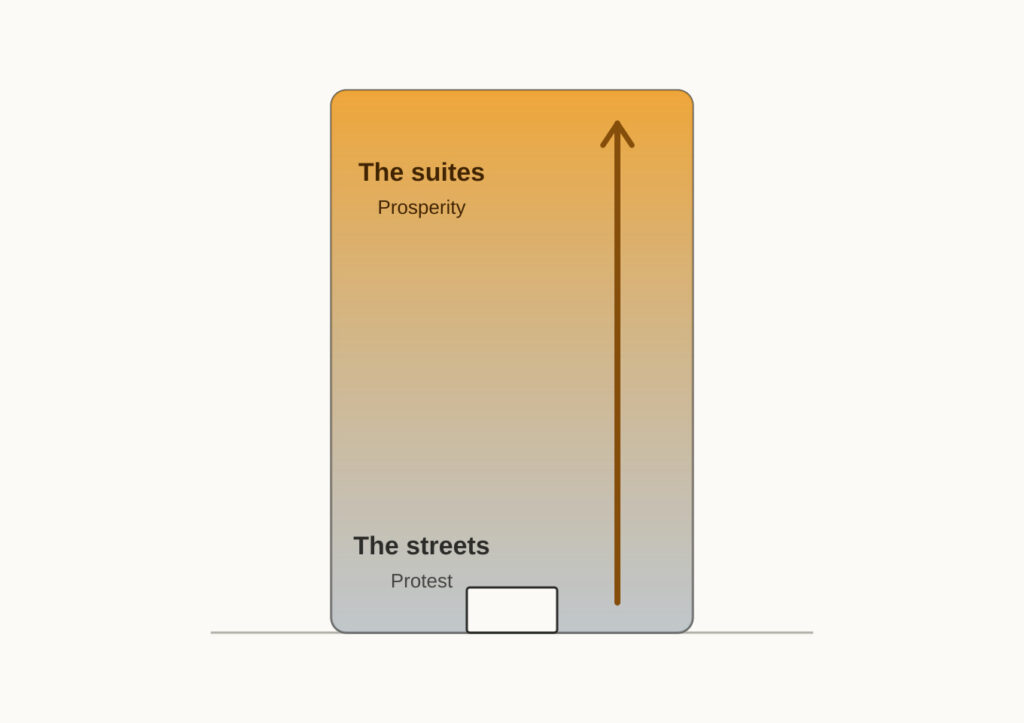
That is where the term Silver Rights comes from, and it is not a rebrand of civil rights. It is the other half of the same fight, the half that doesn’t always get remembered: civil rights in the streets, silver rights in the suites. It took both.
I want to be precise about the distinction, because it matters. Civil rights was fundamentally about race — about the color line, about who was allowed where. Silver rights is fundamentally about class — about who has access to capital, credit, ownership, and the tools that turn a paycheck into wealth. Here’s the thing people miss: when you actually deal with class, you often end up addressing race anyway, because in this country the two have never been fully separable. But naming the real target matters. The real color that unites every community locked out of this economy — Black, white, rural, urban, immigrant, native-born — is not a color at all. It’s green.
This is why I’ve never described my life’s work as being only about race, even though race is inseparable from the history that got us here. Operation HOPE was built to serve anyone standing outside the economy looking in, because the mechanics of exclusion — no bank account, no credit history, no one who ever taught you how a loan actually works — do not check your skin color before they close the door on you.
The Silver Rights Movement is, in the truest sense, the economic engine of what I’ve come to call the Third Reconstruction. If the First Reconstruction was about freedom and the Second was about rights, the Third is about results — and results get built the same way Andrew Young built them in those back rooms sixty years ago: not through slogans, but through access. A bank account. A credit score you understand and can build. A business plan. Ownership of something that compounds.
The tools have changed enormously since 1955, and that is the actual opportunity sitting in front of this generation. Andrew Young needed a hundred business leaders in a room and months of patient, unglamorous negotiation to move one town. Today, the equivalent of that negotiation is available to an individual directly — a free credit report, a business plan template, an AI tool that puts financial guidance in your pocket for less than a car payment. The suites Dr. King’s movement had to gain access to through back-channel diplomacy are, in a meaningful sense, more open than they have ever been. What’s missing for too many people is not the door. It’s knowing the door is there, and knowing how to walk through it.
That is the whole of what I mean when I say silver rights. Not a metaphor. Not a slogan for a T-shirt. A literal, practical movement — from the streets to the suites, from protest to prosperity — built one credit score, one small business, one financially literate teenager at a time.
Nearly half of all employers in this country run a credit check before they’ll even consider hiring you. Read that twice. Your financial history is now, quietly, a gatekeeper to your professional future, whether anyone explains that to you or not. That single fact is why I consider financial literacy the civil rights issue of this generation, and why the Silver Rights Movement isn’t a historical footnote — it’s an active, unfinished campaign, and every person who raises their credit score, opens their first business account, or teaches a teenager what a compound interest rate actually does is, in a very real sense, still fighting it.
Dr. King never got to finish this part of the work. He was assassinated while pivoting toward the Poor People’s Campaign, the piece of his agenda most directly concerned with economic justice for the poor of every race. I have spent more than three decades trying to pick up that thread, because I believe he was right about where the movement needed to go next, and because the alternative — leaving that work undone for another sixty years — is not something this country can actually afford.
Civil rights opened the doors. Silver rights is what you do once you’re standing inside the room. Both were necessary. Only one is finished.
Pick one door. Walk through it. Then hold it open for the next person.
John Hope Bryant — founder of Bryant Group Ventures, Operation HOPE, Inc, publisher of the Bryant Journal and author of his 7th book Capitalism for All: Inclusive Economics and the Future Proofing of America, now a bestseller. Bryant was recently recognized as a member of the Forbes 250 Greatest Living Self Made Americans, on the occasion of the 250th anniversary of America itself. Get the book →