Why the next chapter of American capitalism has to be built on access, not just output
Every few months, someone hands me the same set of numbers and asks me to be impressed. GDP is up. The market is at a record. Spending is resilient. And every few months, I ask the same question back: resilient for whom?
Growth and resilience get treated as synonyms in most economic conversation. They are not the same thing, and the gap between them is where I think the real story of this economy is being written — quietly, and mostly ignored.
Two Economies, Running Side by Side
I’ve said for years that Main Street is not Wall Street. I used to mean that as a warning. Increasingly, I mean it as a literal description of two separate economies operating in the same country at the same time.
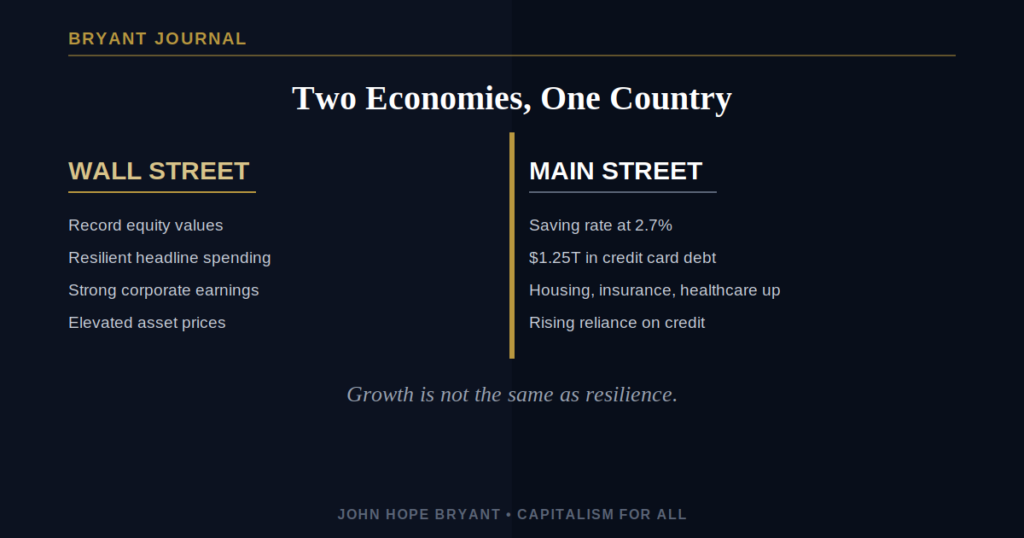
Wall Street’s economy looks fine by almost any measure that gets put on a chart: strong corporate earnings, elevated asset prices, resilient headline spending. Main Street’s economy looks different up close: housing costs that have doubled in many markets, insurance and healthcare eating a larger share of every paycheck, groceries that reset higher and never came back down, and a growing reliance on credit just to keep pace.
An economy can be posting record numbers and still be quietly hollowing out the households holding it up. Both can be true. Right now, both are.
This is not a contradiction in the data. It’s a description of who is actually carrying the spending that keeps the topline numbers looking strong — and it is a narrower group than the headlines suggest. Even the Fed’s own researchers have started using a version of this language. In discussing the latest household debt data, economists at the Federal Reserve Bank of New York described what they’re seeing as a “K-shaped economy” — higher-income households holding steady, lower-income households pulling back and under real strain. I’d argue it’s been K-shaped for longer than the data just started admitting.
Borrowed Time Is Not the Same as Strength
Look underneath resilient consumer spending and you tend to find three things propping it up: a concentration of spending power at the top of the income ladder, savings being drawn down faster than they’re being rebuilt, and credit expanding to cover the difference for everyone else.
The personal saving rate stood at just 2.7% in June 2026, according to the Bureau of Economic Analysis — well below the long-run historical average, and a clear sign of how much of today’s spending is coming out of the tank rather than off the top. Credit card balances tell the same story from the other direction: $1.252 trillion outstanding as of the first quarter of 2026, according to the Federal Reserve Bank of New York — up 63% since the pandemic-era low just five years earlier, and part of a total household debt load that just hit a record $18.8 trillion.
None of those are permanent engines. They’re all borrowed time, in one form or another — borrowed from savings accounts, borrowed from future income, borrowed against home equity or a credit line. An economy that depends on borrowed time to hit its growth targets isn’t demonstrating strength. It’s demonstrating how long a foundation can be quietly weakened before something has to give.
That’s the distinction I want to draw a hard line under: growth measures output. Resilience measures whether that output can survive contact with reality — a bad quarter, a rate hike, a job loss, an unexpected bill. An economy that only holds together as long as nothing goes wrong for the people carrying it isn’t resilient. It’s fragile, dressed up as strong.
What Resilience Actually Requires
This is where I think the conversation usually goes wrong. The instinct, when growth looks fragile, is to ask how to protect the growth. I think that’s the wrong question. The right question is how to broaden who the growth actually reaches — because an economy where more people have real access to credit, to financial literacy, to the tools that turn a paycheck into an asset isn’t just fairer. It’s structurally sturdier. It doesn’t buckle the moment the top of the income ladder gets nervous, because it was never balanced on that narrow a base to begin with.
This is the entire argument at the center of my new book, Capitalism for All. Inclusive economics isn’t a moral argument bolted onto capitalism from the outside. It’s the load-bearing wall. Capitalism only earns its name — only functions the way it’s supposed to — when access to it is actually broad enough to hold the weight of the whole economy, not just the households that already have it.
The Proof Isn’t Theoretical
I don’t make this argument in the abstract. Operation HOPE has spent more than three decades testing it directly: over $5 billion deployed since 1992, more than 4 million people served, over 1,500 HOPE Inside locations built inside the same communities most economic conversations forget to mention. The 1MBB partnership with Shopify alone has helped more than 450,000 small businesses get access to tools that were, for most of American history, reserved for people who already had capital.
None of that is charity accounting. It’s evidence that when you close the access gap — real credit, real financial literacy, real tools — the result isn’t just individual families doing better. It’s an economy with a wider, more durable base.
My own mother is the proof of concept I return to most. Juanita Smith worked an hourly wage for thirty-two years. She bought and sold seven homes over her lifetime, each a step up from the last, and built an 854 credit score without anyone sitting her down to explain the mechanics — she pieced it together herself, one decision at a time. When she passed, she left behind a net worth in seven figures. That’s not a story about luck. It’s a story about what happens when someone gets even a partial version of the access this country still doesn’t extend broadly enough.
The Unfinished Work
I call the work still in front of us the Silver Rights Movement. The civil rights movement won the right to sit anywhere on the bus, to vote, to walk through any door in this country. It did not, on its own, win the right to build wealth once you were through that door. That’s a separate fight — an economic one, not a racial one — and it’s the one still unfinished.
The businesses and policymakers paying attention to this aren’t doing it out of charity either. The math is straightforward: an economy that depends on a shrinking, narrow base of spenders is running out of runway, whether or not this quarter’s numbers say so. The ones who figure out how to widen access — to credit, to ownership, to the tools that convert income into wealth — aren’t just doing the right thing. They’re building the only version of this economy that actually holds up.
Growth tells you what happened last quarter. Resilience tells you what’s still standing when the quarter goes badly. I’d rather build for the second one.
This essay is one argument out of many in Capitalism for All: Inclusive Economics and the Future-Proofing of America — out now, and a National Bestseller. If the distinction between growth and resilience is one you want to sit with longer, the book is where I make the full case.
John Hope Bryant — founder of Bryant Group Ventures, Operation HOPE, Inc, publisher of the Bryant Journal and author of his 7th book Capitalism for All: Inclusive Economics and the Future Proofing of America, now a bestseller. Bryant was recently named a member of the Forbes 250. Get the book →
For the shorter, more immediate version of this argument — written in real time as the data comes in — subscribe on Substack →
Sources
Personal saving rate (June 2026): U.S. Bureau of Economic Analysis, Personal Income and Outlays, June 2026.
Credit card balances and total household debt (Q1 2026): Federal Reserve Bank of New York, Quarterly Report on Household Debt and Credit.