A Bryant Journal Foundational piece
Every so often, a country has to stop and decide, out loud, who actually gets to belong to it. Not on paper. Not in theory. In practice — in bank accounts, in property deeds, in who gets to sit at the table where the decisions are made.
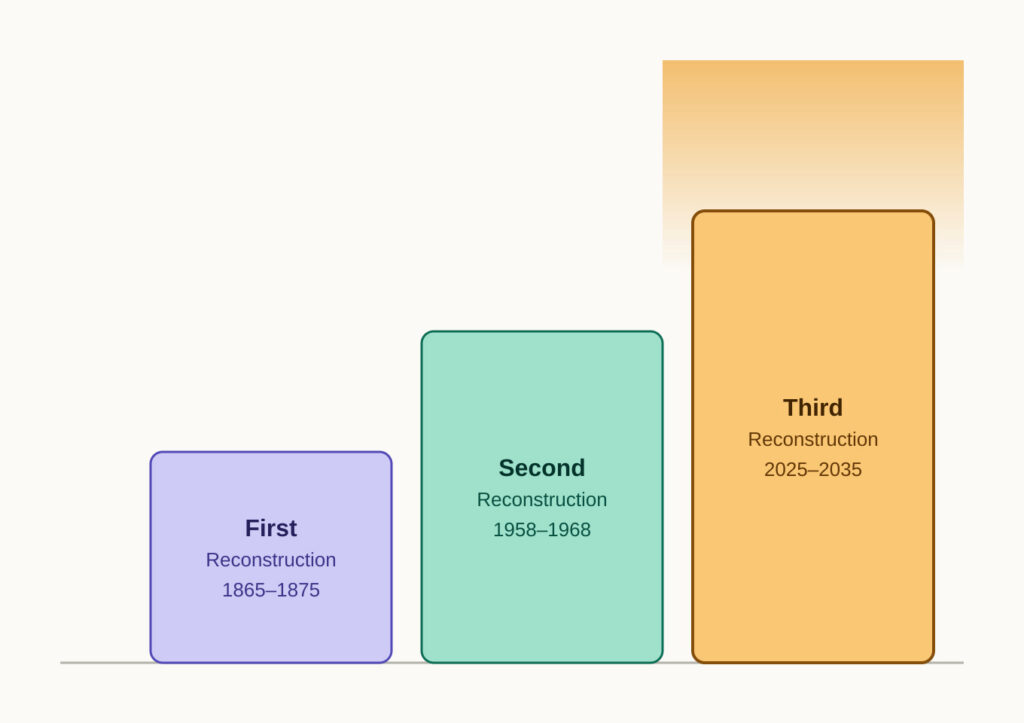
America has done this three times now. I call them the three Reconstructions, and I believe we are living through the third one right now, whether we have noticed it or not.
The First Reconstruction: 1865 to 1875. Freedom.
After the Civil War, the question in front of the country was about as big as a question gets: would America actually make good on freedom for four million people who had, the day before, been legally classified as property?
For a moment, it looked like yes. In January 1865, General William T. Sherman issued Field Order 15, setting aside land for Black families — forty acres each. A month later, Army mules were added to the plan. That is where “forty acres and a mule” comes from, and it was not a folk tale. It was policy, on paper, moving toward becoming real. Then, on March 3, 1865, President Lincoln signed the Freedman’s Bureau into law, which created the Freedman’s Bank to serve people who had been locked out of wealth-building for 246 years. I consider that one of the most progressive economic acts in American history, full stop, measured against the moment it happened in.
Then it fell apart, fast. Lincoln was assassinated the next month. His successor, Andrew Johnson, rolled back the land grants and handed much of that land back to former Confederates. The Freedman’s Bank itself collapsed less than a decade later, wiping out the very savings of the people it existed to protect.
The First Reconstruction ended without finishing what it started. Freedom got declared. It did not get delivered.
The Second Reconstruction: 1958 to 1968. Civil Rights.
Almost a hundred years later, the country faced a version of the same question again: would the full rights of citizenship — not just the vote, but the whole apparatus of full participation — actually extend to Black Americans? From the Montgomery Bus Boycott to the March on Washington, from the Civil Rights Act of 1964 to the Voting Rights Act of 1965, this era delivered real, structural, legal change. I don’t say that lightly, and I don’t say it as a formality. That progress was earned at enormous cost, and it mattered.
It also cracked a door open that people don’t always connect to this era: as late as 1972, a woman in this country could not open a bank account or take out a loan without her husband’s signature alongside hers. That began to change in the wake of the Civil Rights Movement, and the economic case for it turned out to be undeniable — women now contribute seven to eight trillion dollars annually to the American economy. If the country had bet against that change, it would not be the largest economy in the world today. It bet right.
But the Second Reconstruction left unfinished business too. Dr. King was assassinated in April 1968, just days after his “I’ve Been to the Mountaintop” speech — and at the time of his death, he and my mentor and personal hero Ambassador Andrew J. Young were pivoting toward the Poor People’s Campaign, an agenda that deliberately included poor white Americans in Appalachia and the rural South alongside Black and Brown communities. He had figured out, right at the end, that economic justice was the actual final frontier of civil rights. He did not live to build it.
The Third Reconstruction: 2025 to 2035. Capitalism for All.
I believe this is the decade we are standing inside of right now, whether the country has fully named it yet or not. The cracks in the country’s economic foundation are visible to anyone willing to look at them honestly. My hope — and increasingly, my working assumption — is that the years between 2025 and 2035 will be remembered as America’s Third Reconstruction: the one focused on economic inclusion.
Here’s how I’d put the arc together. The First Reconstruction gave us freedom. The Second gave us rights. The Third has to give us results — specifically, real economic opportunity, reaching real communities, showing up in the actual instruments people build a life on: bank accounts, business ownership, home equity, credit scores.
This is the era I’ve come to call Silver Rights — the movement from the streets to the suites, from protest to prosperity. And like the two Reconstructions before it, this one is not going to happen automatically. Nothing about the first two did, either. It is a choice, and it has to be fought for — not with violence, but with vision, with policy, and with the kind of person-by-person, ledger-by-ledger commitment that no piece of legislation can substitute for.
I did not build Operation HOPE, or write *Capitalism for All*, because I think the first two Reconstructions were failures. I built it because I think they were unfinished. Each one moved the ball as far as its own tools could carry it — a land grant, a bank charter, a law, a vote. The tools available to this Reconstruction are different, and in some ways they are more powerful than anything the first two generations had access to: a credit score you can actually see and build. A business plan that costs nothing to draft. An AI tool that puts a financial advisor in your pocket for less than the price of a car payment.
The first two Reconstructions were won, in large part, by people who did not have the tools this one has. That is not an accident of history to feel guilty about. It is an inheritance to put to work.
Pick one door. Walk through it. Then go back and help build the stairs for the next person behind you.
That has always been the assignment. It is simply, once again, our turn to carry it.
John Hope Bryant — founder of Bryant Group Ventures, Operation HOPE, Inc, publisher of the Bryant Journal and author of his 7th book Capitalism for All: Inclusive Economics and the Future Proofing of America, now a bestseller. Bryant was recently recognized as a member of the Forbes 250 Greatest Living Self Made Americans, on the occasion of the 250th anniversary of America itself. Get the book →