John Hope Bryant and Anthony Anderson Bring Books, Brotherhood, and Big Dreams to Walmart’s Newest Store in Texas
We did not plan this. Nobody sat in a room and said, “Let’s get two guys who grew up in Compton, California, put them at the same table in a brand-new Walmart in one of the fastest-growing cities in America, and have them sign books about capitalism and barbeque.” But that is exactly what happened. And sometimes the moments you do not plan are the ones that mean the most.
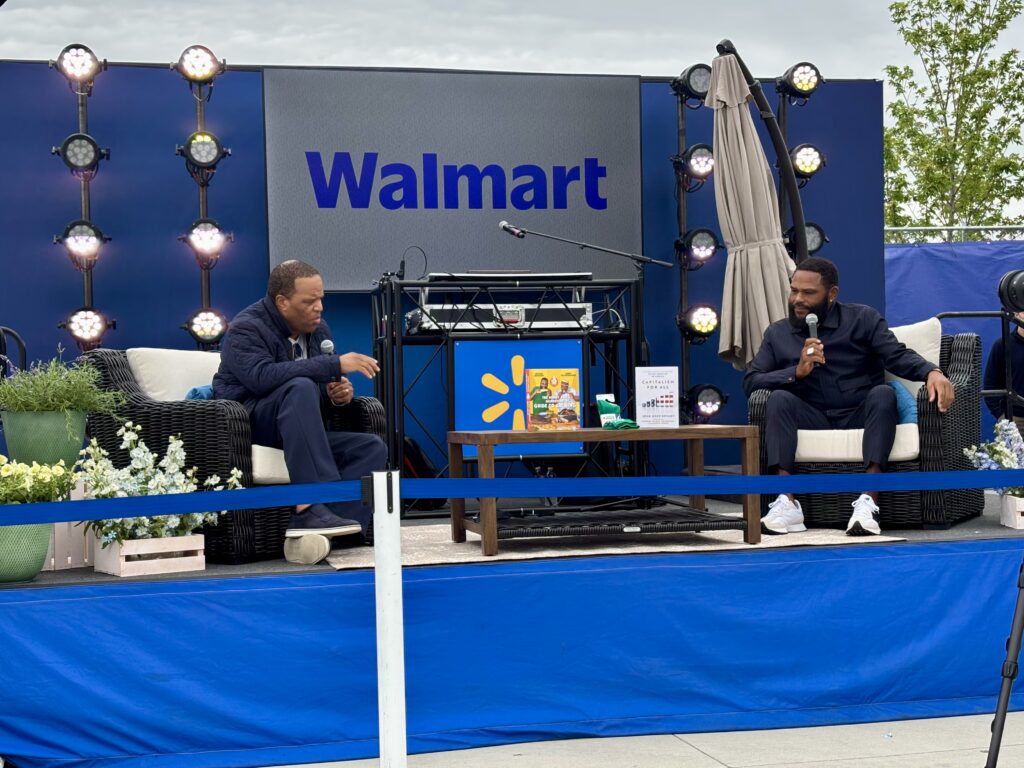
Walmart invited me out to their new Supercenter in Celina, Texas — a booming exurb north of Dallas — to sign copies of my book Capitalism for All: Inclusive Economics and the Future-Proofing of America as part of the store’s grand opening. When I got there, I learned that the actor Anthony Anderson would be signing alongside me, promoting his new cookbook AC Barbeque: The Husky and Handsome Guide to Grilling, written with Cedric The Entertainer. Two authors. One table. And a line of families that stretched deep into the store.
What nobody in that line knew — and what hit me the moment Anthony and I locked eyes — is that we are both from Compton.
I have said many times that your zip code should not determine your destiny. Anthony Anderson is living proof of that. Born and raised in Compton. Graduated from Howard University — going back decades later to finish what he started, earning his Bachelor of Fine Arts at the Chadwick A. Boseman College of Fine Arts. He built a career that includes an Emmy-nominated, culture-defining run on Black-ish, years on Law & Order, a hosting gig at the Primetime Emmy Awards, and now, a legitimate entrepreneurial brand with AC Barbeque. The man took his love of food and family and built a business out of it. That is not fame. That is free enterprise.
And that is exactly what Capitalism for All is about — the idea that the tools of this economy, the same tools that built every Fortune 500 company in this country, should be available to everyone. Including two kids from Compton who never had a guarantee of anything.
I want to tell you about Celina for a moment, because this town is the story.
A decade ago, Celina had about 7,000 people. Today, it has more than 50,000 — and it is still growing. The Census Bureau recently identified it as one of the fastest-growing cities in America. The Walmart we signed books in is no ordinary store. It is one of the retailer’s most contemporary formats, anchoring the Shawnee Trail development — a 150-acre, billion-dollar mixed-use project that includes housing, restaurants, parks, and a future amphitheater. This is a community building itself from the ground up.
I wrote about this in my recent TIME column, because what happened in Celina that day got me thinking. Why did Walmart choose this particular exurb for a major store opening and an author event? The answer is aspiration. Celina is a place where families are planting roots, where businesses are opening every month, where people are betting on the future. That is the kind of community that Capitalism for All was written for — not Wall Street, not Washington, but the places where ordinary Americans are doing the extraordinary work of building a life.
And there we were, Anthony and I — two brothers from Compton — sitting right in the middle of it.
Here is what I keep coming back to.
Anthony’s book is about barbeque — the recipes, the regions, the traditions passed down through generations at backyard cookouts and family reunions. My book is about capitalism — how we expand the economic ladder so more people can climb it. On the surface, those could not be more different. But underneath, the message is the same. Both books are about what happens when people from communities that the world underestimated refuse to stay small. Both books are about turning culture and conviction into something you can build on.
Anthony turned his love of food into a product line carried in thousands of stores and a hit A&E show. I turned a financial literacy lesson I heard in a Compton classroom at age nine into Operation HOPE, Inc. — the nation’s largest nonprofit provider of financial literacy and economic empowerment, now serving communities through more than 1,500 locations nationwide. Different paths. Same starting line. Same refusal to accept that where you come from has to be where you end up.
My relationship with Walmart goes deep. Doug McMillon, Walmart’s CEO, wrote the foreword to my previous book, Financial Literacy for All, and serves as my co-chair on the Financial Literacy for All Initiative. That book was featured in 2,000 Walmart stores across the country. When Walmart commits to community, they mean it. And when they open a store in a place like Celina and invite two authors from Compton to be part of the celebration, that is not coincidence. That is a statement about what this economy can be.
I told Anthony that day what I will tell you now. The best version of America is not a theory. It is two brothers from Compton sitting at a table in a Walmart in Texas, signing books about the things they love, surrounded by families who showed up because they believe the future is still worth building.
We were not born with silver spoons. We were born with something better — the stubborn belief that we belonged in any room, at any table, in any town in this country.
Celina, Texas did not know it that day, but it was looking at the American Dream in stereo.
Let’s go.
John Hope Bryant is the Founder, Chairman & CEO of Operation HOPE, Inc. and Bryant Group Ventures. His latest book, Capitalism for All: Inclusive Economics and the Future-Proofing of America, is available now at all major booksellers including Amazon, Barnes & Noble, and Walmart. Listen to Bryant’s conversation with Anthony Anderson on the Money & Wealth podcast, available on iHeartRadio and wherever you get your podcasts.
John Hope Bryant — founder of Bryant Group Ventures, Operation HOPE, Inc, publisher of the Bryant Journal and author of his 7th book Capitalism for All: Inclusive Economics and the Future Proofing of America, now a bestseller. Bryant was recently named a member of the Forbes 250.